Tuesday, January 31, 2006
Now 'Fat-free' is not always best, nor is spinach: "Reduced fat does not necessarily mean low fat, raspberry flavoured yoghurt may not contain raspberries at all, and Popeye was wrong - spinach is not a good source of iron. These are some of the food myths busted by the Australian Consumers' Association in a Choice Online publication. The internet booklet focuses on food, diet and food labelling. Choice Online spokeswoman Clare Hughes said just because a food was described as fresh or natural it did not mean it was healthier than some other foods. "A claim that a product is baked not fried does not mean the product is lower in fat," she said. "Baked products may contain just as much fat as food cooked in fat if they contained lots of fat to start with. "Also fat-free foods are not necessarily the best choice if you are trying to lose weight because fat free does not necessarily mean kilojoule free." Other myths exposed in the booklet include: * Organic foods are better for you. Choice Online says nutritionally there is little evidence to support this, nor is there evidence that organic foods taste better... * Soy crisps are healthier than potato chips. Choice Online says they may sound healthier but, cooked in vegetable oil, they contain just as much fat... * Reduced fat does not mean low fat. Choice Online says a product needs only to have 25 per cent less fat than a regular brand to meet reduced fat requirement... When it comes to spinach, it is an excellent source of fibre, folate and vitamin C but its high levels of iron are not much use to the body because it also contains oxalic acid that prevents much of the iron from being absorbed.
Now even the dreaded radiation is good for you: "The good news came in the form of a study published in the journal Cancer which found that low doses of radiation, given every weekday for one or two weeks, could improve outcomes for non-small-cell lung cancer. The cancer was one of the deadliest and most common forms of lung cancer, according to radiation oncologist Michael Mac Manus from Melbourne's Peter MacCallum Cancer Centre. Associate Prof Mac Manus and his colleagues were amazed to find that some patients with advanced tumours lived for as long as five years with the new treatment. Usually they would have been expected to live less than six months. "All experienced doctors will have come across an occasional case where a patient has survived for a long time when they shouldn't have, so we thought we would look at a very large database of patients with incurable lung cancer to see how many of them survived," Prof Mac Manus said. "We were surprised to find that 1.1 per cent survived for five years. Some of them survived for 10 years and (one of) the patients appears to have been cured. "The long-term survival was an unexpected effect of the radiotherapy"
Alzheimers? No problem! "Research news in the Journal of the Science of Food and Agriculture Compounds in blackcurrants could prevent Alzheimer's disease and the characteristics of British berries suggest they do it best, writes Jennifer Rohn in Chemistry & Industry magazine. New research led by Dilip Ghosh of the Horticulture and Food Research Institute in New Zealand, shows that compounds in blackcurrants have a potent protective effect in cultured neuronal cells against the types of stress caused by dopamine and amyloid-b, a peptide associated with Alzheimer's disease... Blackcurrants and boysenberries, more common in the US, both contain anthocyanins and polyphenolics. British blackcurrants are bred to be darker, which means they have more anthocyanins and are likely to be more potent. Compounds from these berries are already known to act as antioxidants, but a role in neuroprotection has not been demonstrated previously, according to the researchers. The mechanism of action is unclear".

Sunday, January 29, 2006
FOOD FASCISTS ATTACK ADVERTISING VIA THE COURTS
"Look!" exclaims my 3-year-old daughter, pointing excitedly at a box of cookies in the supermarket. "It's Dora! And Boots!" I nod and smile. "Yes, it is," I say, and we move on. I do not feel injured by this exchange. But according to the Center for Science in the Public Interest (CSPI), a D.C.-based health nanny group, if I lived in Massachusetts the incident would be worth at least $25 in statutory damages.
Using that sort of reasoning, CSPI, the Boston-based Campaign for a Commercial-Free Childhood, and two Massachusetts parents who would rather sue multinational corporations than stand up to their own children are seeking billions of dollars in damages from Viacom (which owns Nickelodeon, home of "Dora the Explorer" and Kellogg, maker of sugary breakfast cereals and other food products CSPI thinks your kids shouldn't eat. The plaintiffs say it's not about the money.
I believe them. This lawsuit, which CSPI and its allies plan to file under a Massachusetts consumer protection statute prohibiting "unfair or deceptive acts or practices," is really about censorship. By threatening onerous damages, CSPI aims to achieve through the courts what it has unsuccessfully demanded from legislators and regulators for decades: a ban on food advertising aimed at children.
The lawsuit argues that Viacom is on the hook for $25 "at a minimum" every time a kid in Massachusetts sees one of its characters attached to a "nutritionally poor" food product or sees an ad for such a product on Nickelodeon or in another Viacom outlet. By CSPI's reckoning, Kellogg owes $25 whenever a child sees one of its ads, so an Apple Jacks commercial on Nickelodeon is worth $50 per viewer every time it airs. "The injury continues ... each time a parent purchases one of these items," says CSPI in a letter announcing its intent to sue. So if a parent, helpless to resist a preschooler's demands, actually buys the Dora cookies or the Apple Jacks, that's another $25 in damages. You can see how the bill starts to add up.
But all the talk of injuries and damages is a charade. As obesity litigation advocate Richard Daynard notes in this month's American Journal of Preventive Medicine, one advantage of suing food companies under state consumer protection statutes is that it "avoids complicated causation issues." Most of these laws "do not require a showing that the defendant's misbehavior caused a specific illness," writes Daynard, a Northeastern University law professor who plans to join CSPI in using such statutes to stop soda manufacturers from selling their products in schools. Indeed, "many state consumer protection statutes do not require a showing that individual plaintiffs relied on the [defendant's] misrepresentations."
Under the theory pressed by CSPI in its suit against Viacom and Kellogg, you don't even have to show that the companies misrepresented anything. CSPI argues that children "are intrinsically deceived and abused by encouragement to eat unhealthy junk foods," and it's seeking an injunction to stop all such encouragement.
While I have no doubt that advertising encourages children to request certain products, what happens after that is up to their parents. Neither Viacom nor Kellogg has the power to dictate whether SpongeBob SquarePants Wild Bubble Berry Pop-Tarts are purchased, how often and in what quantities they're eaten, what else children eat or how much exercise they get.
"Nickelodeon and Kellogg engage in business practices that literally sicken our children," says CSPI Executive Director Michael Jacobson. Given the difficulty of demonstrating a causal connection between seeing Dora the Explorer on a box of cookies at age 3 and dying from obesity-related heart disease half a century later -- precisely the difficulty CSPI is trying to avoid by filing this kind of suit -- it would be more accurate to say these business practices figuratively sicken people like Michael Jacobson. The question is how much weight the law should give to Jacobson's queasy gut.
Source
More pseudo-science about food: "Eating your greens will do more than please your mother: new evidence shows five servings of fruit and vegetables a day can slash your risk of having a stroke by 26 per cent. A review of previous studies, conducted by British and Australian experts, found that even eating between three to five 80g servings a day cut strokes by 11per cent, compared with people who ate fewer than three servings a day. The authors said that while a reduction in stroke from fruit and vegetable consumption was already known, this was the first time researchers had been able to quantify the benefit. The findings suggested that heeding recommendations on fruit and vegetable intake could save lives and prevent thousands of strokes a year.... Their review, published yesterday in The Lancet, looked at the results of eight previous studies that together involved more than 250,000 people who were followed up for an average of 13 years.... The study authors conceded their results might be affected by observational bias. People who ate a lot of fruit and vegetables were probably likely to share other characteristics known to reduce stroke risk - being less likely to smoke or be overweight, and more likely to exercise and to have lower intakes of salt and saturated fat.
Yuk!: "Over the last two years, three women with strange skin conditions have sought help from Dr. Michael A. C. Kane, a plastic surgeon in New York City. One had bumps the size of capers bulging from her lips. One's forehead was red with inflammation. And a third had ridges that looked to Dr. Kane like worms nestled below her eye sockets. All of these problems had been caused by injections of liquid silicone, one of the most controversial substances in cosmetic medicine. Long used without official sanction and then banned by the Food and Drug Administration, liquid silicone was finally approved for medical use in 1997: to hold detached retinas in place. And it has been gradually regaining popularity, as doctors use it off-label to fill wrinkles, furrows and acne scars or add volume to lips and cheeks".
FDA: You're eating crushed bug juice: That ice cream you're eating or the lipstick you're wearing just might contain extract from crushed bugs. On purpose. And the government thinks you should know. The Food and Drug Administration proposed Friday requiring food and cosmetic labels to list cochineal extract or carmine if a product's ingredients include either of the two red colorings that have been extracted from the ground bodies of an insect known since the time of the Aztecs.
Saturday, January 28, 2006
Don't trust the "latest" medical research: "When a trial of 908 volunteers found that using anti-inflammatory drugs could reduce the risk of mouth cancer, it caused considerable excitement among cancer researchers. The Harvard School of Dental Medicine described the study as impressive, claiming it might lead to earlier identification of pre-cancerous cells. Conducted by Dr Jon Sudbo, a previously-published researcher and cancer expert from the well-respected Radium Hospital in Oslo, Norway, the study was published in The Lancet, one of the world's most respected medical journals. So it came as a shock when revealed earlier this month that Sudbo's study was fiction, based on 908 patients who did not exist. To make matters worse, the fraud was not discovered by The Lancet or his colleagues, but by Camilla Stoltenberg, a director of epidemiology at the Norwegian Institute of Public Health in Oslo. Sudbo said the study was based on information collated from a public health database. Stoltenberg, responsible for the database, knew it did not contain the sort of information Sudbo cited".
Thursday, January 26, 2006
THE FOOD FASCISTS HAVE GONE TOO FAR THIS TIME
I enjoyed the haggis I had on my Burns Night. Attacking a central part of the Scottish heritage is certainly not wise. The Scots are very proud of their heritage
Scotland's national dish, haggis, has become the latest foodstuff to be targeted as part of a drive to combat growing levels of obesity among British children, prompting outrage among producers. According to health officials in Scotland, the delicacy -- a sheep's stomach lining stuffed with offal, oatmeal, onions and seasoning -- contains too much fat and salt and should only be given to youngsters once a week.
But the guidance has angered makers of the "love it or hate it" foodstuff, which is traditionally eaten with a tot of whisky on Burn's Night, the annual January 25 celebration of the life of the legendary Scots poet Robert Burns. "With good neeps and tatties (turnips and potatoes), there's nothing more nutritious than haggis," said Alan Pirie, of butchers James Pirie and Son, the current holders of the sought-after title "Scottish Haggis Master". "It's made of all natural ingredients -- there's no rubbish in it at all. To compare it with processed meat like chicken nuggets or hot dogs is just ridiculous. It's a big knock for us for it to be compared to those."
Haggis was placed on a "restricted" list of foods issued to nurseries, playgroups and childminders as part of a drive by the Scottish Executive in Edinburgh to improve the health of pre-school children under five. The numbers of obese children in Scotland is twice the British average; 20 percent of three-and-a-half-year-olds were overweight, 8.6 percent obese and four percent severely obese in the 2004-05 school year, official statistics show. Mortality rates among adults, particularly in the densely populated "Central Belt" between Glasgow, in the west, and Edinburgh, in the east, are also among the highest in Europe, mainly through alcohol, smoking and a high-fat diet.
The Scottish Executive, which has made a number of moves to improve the nation's health, including an imminent ban on smoking in public places, insisted haggis was not being outlawed but should be eaten in moderation. "The nutritional guidelines are intended to give advice on how to provide a balanced diet over a week," said a spokeswoman. Preventing an obesity epidemic in Britain has been the subject of a number of government initiatives in recent years, including improving school dinners in England and Wales with the help of celebrity chef Jamie Oliver.
Source
Soy not much help in health of hearts: "Veggie burgers and tofu might not be so great at warding off heart disease after all. An American Heart Association committee reviewed a decade of studies on soy's benefits and came up with results that are casting doubt on the health claim that soy-based foods and supplements significantly lower cholesterol. The findings could lead the Food and Drug Administration to re-evaluate rules that allow companies to tout a cholesterol-lowering benefit on the labels of soy-based food. The panel also found that neither soy nor the soy component isoflavone reduced symptoms of menopause, such as 'hot flashes,' and that isoflavones don't help prevent breast, uterine or prostate cancer. Results were mixed on whether soy prevented postmenopausal bone loss."
Sex makes you a more confident speaker: "People who are nervous about public speaking should first have penetrative sex to ease the stress, although masturbation is unlikely to have the same effect, according to an unusual study. Stuart Brody, a psychologist at Britain's University of Paisley, compared the impact of different sexual activities on blood pressure when a person later undergoes a stressful experience. Mr Brody asked 24 women and 22 men to keep a diary of their sexual activities for two weeks. The volunteers then underwent a stressful ordeal that involved making a speech in public and doing mental arithmetic out loud. The study, to be published in next Saturday's New Scientist, revealed volunteers who had had penetrative sex during the previous week or so had the least stress, and their blood pressure returned to normal fastest after their test. Penetrative sex was far more effective in this regard than masturbation or oral sex. Those who had abstained completely from any sexual activity had the highest stress levels and blood pressure of all".
Wednesday, January 25, 2006
NOW THE FOOD FASCISTS ARE CLAIMING THAT A MODERN DIET IS SENDING US MAD
Panic: 'Why what we eat has led to rise in mental problems', says the Daily Telegraph, reporting a new study prepared by the food campaign group Sustain and the Mental Health Foundation (MHF). The report surveys research on the effect of various nutrients and foods on mental development and illness. The report suggests that industrialised farming and changing patterns of eating may be leading to the loss of vital nutrients and imbalances which can effect brain formation, concentration and memory. The suggestion is that rising levels of attention-deficit hyperactivity disorder (ADHD), schizophrenia and Alzheimer's may all be related, in part, to diet.
Don't panic: Coverage of the Sustain/MHF report has been much more definitive about the conclusions drawn than the report itself. At the very start, the author notes that it is not a systematic review of the literature and that there is a distinct bias towards studies that show a link between diet and mental health. So, the author suggests the report should not be read as a definitive statement on the science, but as an awareness-building exercise. 'Advocacy research' might be nearer the mark.
Even some of the basic assumptions need to be called into question. It is far from clear that there has been a real increase in mental health problems over the last few years. In a society increasingly obsessed with health and the inability to find a wider meaning to life, many behaviours previously regarded as normal variations of personality are being redefined as mental illness. Moreover, if there has been any increase in mental health problems, those same navel-gazing trends must be a prime candidate as an explanation. Increasing levels of drinking, drug-use and the decline of traditional patterns of family and working life could all represent a stronger explanation than our failure to eat enough oily fish.
In the foreword, Professor Tim Lang of City University makes the analogy with heart disease and diet. The heart disease-diet link is well-established now, he suggests, and the mental health-diet link must surely follow. In reality, while our diets are allegedly getting worse, death rates from coronary heart disease for those under 75 have tumbled in the past 30 years. Far from confirming his case, the analogy only illustrates how 'common sense' explanations of ill-health need to be treated with caution.
Still, the provisional nature of the research hasn't stopped Sustain from packing the report's recommendations with their own particular hobby-horses. For example, 'All prison facilities should instigate sustainable food policies and practices so that all residents and staff are encouraged to choose culturally diverse and appropriate meals, snacks and drinks that promote their mental, emotional and physical wellbeing.' What have cultural diversity and sustainability got to do with whether we getting enough selenium or iodine in our food?
It is true that at a fundamental level, 'we are what we eat' - but we are much more than the sum of the nutrients that make up our bodies, and our minds are much more than the chemical make-up of our brains.
Source
Monday, January 23, 2006

Jap makes young wine old: "Aging is the name of the game when it comes to fine wine. Top producers mature their brews in oak barrels; connoisseurs will keep a bottle in the cellar for years so they can savour the complex bouquet at its peak. For Hiroshi Tanaka, all that waiting is just a waste of time - and he says he's got the machinery to prove it. Tanaka claims to have perfected a machine that can transform a bottle of just-fermented Beaujolais Nouveau into a fine, mellow wine in seconds, all by zapping it with a few volts of electricity. "We can now electrolyze young wine and ship bottles of fine wine out in no time at all," declared Tanaka, president of Japanese startup Innovative Design and Technology, which runs a small laboratory in Hamamatsu, west of Tokyo. "Think of the savings we'll make. Shorter production time, no need for storage, no need to invest in barrels," he said."
Sunday, January 22, 2006
Suspended animation success: "Researchers are testing potentially life-saving techniques for keeping humans in a state of suspended animation while surgeons repair their wounds. US doctors have developed a method of inducing hypothermia to shut down the body's functions for up to three hours. In tests, they reduced the body temperature of injured pigs from 37C to 10C before operating on them and then reviving them. Now they are applying for permission to test the procedure on casualty patients without a pulse who have lost large amounts of blood, New Scientist magazine reported. It is thought this method and others could one day be used on car crash and gunshot victims, as well as in the battlefield to treat wounded soldiers. A surgeon at Massachusetts General Hospital in Boston, Hasan Alam, has tested the technique about 200 times on pigs, with a 90 per cent success rate".
Saturday, January 21, 2006
Mozart Kitsch: "Austria has pulled out all stops to splurge almost $120 million on the biggest birthday bash the little country has ever seen. Throughout this year, the hills, valleys, towns and cities will be alive with the sounds of Mozart music, with classical concerts, music contests, street parties, street musicians, fireworks, banquets and dancing. There are umbrellas, watches, tea cups, ashtrays, commemorative plates, beach towels, handkerchiefs, diaries, pencils and even baby bottles emblazoned with Wolfer's bewigged portrait. The local Stiegl brewery has launched a Mozart Gold beer; there's a new Hiedler Mozart Vintage wine from last year's harvest; an enterprising butcher woke up with a recipe in his head for a new Mozart sausage; and the Alpenmilch dairy has just invented nougat, marzipan and chocolate-flavoured Mozart yoghurt drinks. But the supreme example of Mozart kitsch is "Mozartkugeln", sugary blobs of pistachio, marzipan and hazelnut nougat dipped in chocolate, invented in 1890 by Salzburg confectioner Paul Fuerst and sold to English-speaking visitors as "Mozart Balls"."
Friday, January 20, 2006
Wine and cheese not such a good idea: "It is supposed to be the perfect way to round off a gourmet meal: a wedge of ripe stilton or creamy brie complemented by a glass of fine red wine. Science, however, suggests that wine and cheese - the combination that launched an entire genre of naff parties - are actually false friends. Far from enhancing the bouquet of a quality red, even a cheese as mild as mozzarella will dull the palate to the complex and subtle aromas that make a wine great. Research by a team at the University of California, Davis, suggests that wine buffs should avoid pairing cabernet sauvignon with camembert or pinot noir with Pont l'Ev^que if they want to appreciate their cellars to the full. Hosts seeking to disguise a bottle of cheap plonk, however, should serve up the cheese course straight away. Cheese is an equal opportunities flavour-killer and will mask a bad wine's astringent taste as effectively as it will the rewarding berry tones of a good vintage".
Thursday, January 19, 2006
Apple a day not so healthy, say new food advertising rules: "The natural goodness of fruit could prove its downfall under draft rules that govern how food can be advertised. The proposals by trans-Tasman food regulator Food Standards Australia New Zealand have upset nutritionists and growers, who say they will prevent certain fruits from being legally classified as healthy. Under the draft rules, the amount of sugar will be taken into account, meaning apples, pears and most stonefruit will be disqualified from health claims because their natural sugar levels exceed 16g per serving. The draft standard aims to help people choose better food, but nutritionists say it could harm healthy-eating campaigns such as 5+ a Day, which encourages people to have five or more servings of fruit and vegetables daily".
Wednesday, January 18, 2006
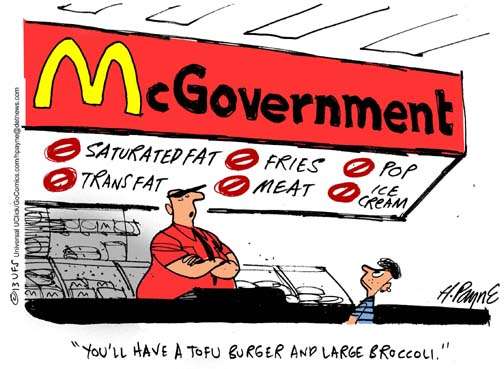
OBESE GOVERNMENT WATCH
Post lifted from The Corner
The Nurse, it seems, is becoming a Chef. From the New York Times:
"Last summer, [New York City's] health department launched a campaign against trans-fats. Often used by restaurants and in packaged foods, trans-fats are thought to cause cholesterol problems and increase the risk of heart disease. After restaurant inspectors found that 30 percent of the city's 30,000 eateries were using oils that contain trans-fats, the department began urging a citywide ''oil change.'' Officials sent letters to food service operators and started teaching workers about trans-fats along with their required food safety training. The city plans another survey this spring to measure the results of the project. Officials next want to tackle portion sizes. Towering pastrami sandwiches, bagels with gooey schmears of cream cheese and pizza slices that spill over paper plates may be the city's culinary landmarks, but the health department says the Big Apple is out of control."
The only thing that is "out of control" is Bloomberg's determination to boss everyone else around. And as to where this is all going to lead, look no further than Elk Grove, Illinois:
"Worried that measures to limit smoking don't go far enough, Elk Grove Village officials are considering banning the sale of cigarettes, apparently the first time that has been seriously proposed in Illinois, experts said. Mayor Craig Johnson said the village would be hypocritical to consider a current proposal to restrict smoking in bars and restaurants without going after cigarettes themselves."If we think smoking is so detrimental to the community that we should ban it, then we should think about a ban on selling cigarettes," Johnson said Wednesday after formally proposing the idea Tuesday to the Village Board."
Words fail me.
Now margarine is bad for you: "Since butter was fingered as the route to a heart attack in the 1970s, many health-conscious consumers have switched to margarine or, increasingly, one of the low-fat alternatives on the market.... Take the latest breed of spreads that promise to lower levels of low-density lipoprotein, the so-called "bad" cholesterol or LDL, thereby cutting your risk of heart attack. These spreads contain plant sterols, also known as phytosterols, which are naturally occurring parts of all plants and have been shown to lower blood cholesterol levels by an average of 10 per cent. Plant sterols block the body's ability to absorb cholesterol, reducing the level of it in the blood. But as with most good things, there is a hitch. "While they certainly lower LDL cholesterol levels, they deplete the levels of beta carotene and other carotenoids in the body," says nutritionist Rosemary Stanton. Beta carotene is the major source of vitamin A in the western diet and there is growing evidence that carotenoids protect the eyes and have anti-cancer properties"
Tuesday, January 17, 2006
More news from the Department of Psychobabble
A sarcastic post about the British "obesity" campaign from a British doctor

"Greetings comrades and good news from the Health Commissariat. Comrade Flint has been made a Hero of the Soviet Union (third class) for designing and instituting the new five-year plan to help comrade doctors advise patients about obesity".
Meanwhile, back at the coalface, Dr Crippen is looking for his chocolate digestive biscuits that the reception staff have hidden to assist him with his flagging New Year's Resolution.
The National Institute of Clinical Excellence (NICE) is working day and night, on your behalf and at your expense, to formulate a national strategy to help family doctors advise patients who are overweight.
 Caroline Flint : Hero of the Soviet Union (Third Class)
In the House of Commons earlier this month, Comrade Flint, an under secretary of state for health said:
"The Department is developing an obesity care pathway as an interim tool to assist the frontline health professionals in managing overweight and/or obese patients, until the availability of the National Institute for Health and Clinical Excellence's definitive guidance in 2007. As part of the process of developing this tool, early drafts were shared with some potential users to ascertain their views on how it might best be applied."
"An interim obesity care pathway". That sounds good! And in another year or so, we will have the "definitive tool". Wonderful! Hang the expense. This is better than "getting a picture of the night" from Sue and Dave.
Dr Crippen will struggle on with the soon to be out-moded equipment he has used to diagnose obesity for the last twenty years. This is a complex photo-electric receptor apparatus which has integral bionic micro-electronic circuitry calibrated automatically to orientate and binocularly co-ordinate the three-dimensional spatial presentation of the propositus in relationship to a complex wooden matrix specially designed by skilled craftsman to admit and contain all members of the population with guaranteed confidence levels up to and including the mean and three standard deviations of the population norm.
In other words, he glances at the patient as they enter the door, and knows instantly if they are overweight.
Then, in the absence of the National Institute for Health and Clinical Excellence's definitive guidance, he says:
"Gosh, you are bit over weight. Why don't you eat less?"
Is this why we cannot afford to treat breast cancer?
My thanks to Comrade Wat Tyler for drawing my attention to the existence of Caroline Flint.
Now softdrinks are good for you: "Fizzy soft drinks may rot your teeth but new research suggests the sugary refreshments also boost the memory. Contrary to conventional health messages, which have branded the high-sugar drinks as unhealthy, researchers in Scotland found that people who consumed 50g of sugar - just over the amount in one can of soft drink - could boost memory retention by almost one-fifth. Neuroscientists from Glasgow Caledonian University said the effects might also help combat dementia in the elderly - and might eventually lead to better ways of treating memory problems in old age".
Monday, January 16, 2006
Testing for prostate cancer is bad for you: "In a carefully designed study, researchers from the Department of Veterans Affairs looked at a group of over 500 patients who had died of prostate cancer, and compared their records with a similar group who had been diagnosed with prostate cancer but had not died from it. They found that those in the first group were just as likely to have been screened for prostate cancer using the PSA test as those in the second group. In other words, PSA testing conferred no survival benefit for these patients...... And the risks of prostate cancer screening are such that it should not be entered into lightly. As usual in debates about screening, there is no such thing as a harmless test. PSA testing is harmful in two ways. Firstly, it has a false negative rate of at least seven per cent. This means that for every hundred men who have the test, 10 will have a raised PSA. All these 10 men will need a prostate biopsy, but only two or three of them will have cancer. So seven or eight cancer-free men will end up having uncomfortable biopsies of their prostate, with potentially serious side-effects such as septicaemia. Secondly, even more problematically, PSA testing does not differentiate between aggressive and potentially fatal cancers, and those which might have had a benign course, never troubling their host. Post-mortem studies have shown that around 40 per cent of men who die aged over 70 have prostate cancer. In the past, most of them would have been blissfully unaware of this fact. In the era of PSA testing, much more of this hidden and harmless prostate cancer is being picked up.... One critic has accurately described this as the 'the eradication of a disease: how we cured symptomless prostate cancer'. Formerly symptomless prostate cancer now has a new symptom: 'a disabling state of anxiety resulting from (men's) knowledge of their PSA level.'"
Saturday, January 14, 2006
Dripping drops out of popularity: "Britons have long had a passion for Chiantishire. Now consumers are turning to olive oil as a wonder food said to help to prevent heart disease and some forms of cancer. According to analysis by Mintel, sales of olive oil have risen by almost 40 per cent in five years, and for the first time the value of standard cooking oils has been overtaken by olive oils. The market is now worth 104 million pounds a year and within five years is predicted to reach 230 million pounds."
The Incorrect Colonel
After I read the following, I decided to eat at KFC tonight:
"Pamela Anderson is leading a charge to remove a bust of KFC founder Colonel Harland Sanders from the state Capitol. The actress called the Kentucky native's likeness "a monument to cruelty" to chickens in a statement issued by People for the Ethical Treatment of Animals, the animal rights group. The statement did little to ruffle feathers in Gov. Ernie Fletcher's office. "Colonel Sanders was one of Kentucky's most distinguished citizens, a great entrepreneur and a fine charitable man of faith"
Source
Human beings are omnivores. We have evolved to eat both meat and plant products. If the PETAnuts want to risk their health with an abnormal diet, that is their privilege -- but trying to force their weird value system on the rest of us is sheer arrogance and insolence.
Friday, January 13, 2006
Meningococcal warning signs: "Noticing your sick child has cold hands and feet, leg pain and abnormal skin colour could make the difference between life and death. Researchers have discovered these are all early warning signs of the dreaded meningococcal disease, which can kill a child within 24 hours. Experts have urged parents and doctors to be more alert for these signs, saying they could give doctors a few vital hours' head-start to begin life-saving treatment. Although meningococcal infection often causes a trademark rash that does not go pale when pressed, this symptom occurs so late it leaves little time to start treatment. While the rash and other classic symptoms such as a stiff neck and headache typically appear as late as 22 hours after first falling ill, the British researchers found 72 per cent of children have the early warning signs - the hallmarks of blood poisoning - within the first eight hours".
Subscribe to:
Posts (Atom)


