Relax, your cellphone won't kill you, experts say
There is no evidence that mobile phones are any more carcinogenic than coffee or pickled vegetables and Australians should be cautious of any mobile phone "gimmicks" promising to reduce radiation exposure, Australian health and bioengineering experts say.
One professor even rounded on top Sydney neurosurgeon Charles Teo for linking mobile phone use with cancer, arguing his view is out of step with mainstream science.
Earlier this month the World Health Organisation (WHO) sparked global alarm after declaring that it was "possible" mobile phones could cause cancer.
But question marks have been raised about whether any reduction in radiation is even necessary, as on the WHO's list of things that could cause cancer, mobile phones sit in the same category as 266 other common products including coffee and pickled vegetables.
Australian experts generally agree that the non-ionising radiation given off by mobile phones is too weak to damage human health.
But University of Wollongong Professor Rodney Croft, executive director of the Australian Centre for Radio Frequency Bioeffects Research (ACRBR), warned people to be cautious about "a number of gimmicks" purporting to reduce mobile phone radiation risks.
He said the WHO's International Agency for Research on Cancer (IARC) did not say that there was a link between mobile use and cancer but rather that they were unable to rule it out because of insufficient data at present.
"Many studies have shown that there is no measurable effect. This is obvious, of course, because there are millions of people using cell phones and if there had been any cancer inducing effect it would have been obvious by now."
Coster said studies had not been able to devise a link between low dose electromagnetic waves and cancer. "So far the only real effect [on human tissue] that has been noted is from intense RF [radio frequency] fields used in MRI machines that can cause light flashes [phosgenes] but even that is rare and requires very strong RF fields." he said.
Coster said that even if users were to completely shield themselves from the electromagnetic signals emitted by phones they would not be able to make calls.
The views about mobile phones and cancer differ markedly from those expressed by Teo, founder of the Centre for Minimally Invasive Neurosurgery at Prince of Wales Hospital in Sydney.
"There is an increasing body of evidence that there is an association between brain tumours and mobile phones," said Teo, adding the WHO report should be a "wake up call" alerting people to the links between mobiles and cancer.
But Croft said Teo's views "do not appear to be consistent with the current state of science".
The largest and longest study of mobile phone use, dubbed Interphone, covered 13 countries and found no overall link between mobile phone use and brain tumours. However, the study, published last year in the International Journal of Epidemiology, also reported that study participants with the highest level of mobile use also had a 40 per cent higher risk for glioma, an aggressive brain tumour.
A separate Israeli study published in The American Journal of Epidemiology found heavy mobile users had a 58 per cent higher risk of parotid gland tumours. The parotid gland is a salivary gland near the ear.
And Swedish research that analysed 16 studies on mobile phone use found a doubling of risk for acoustic neuroma (a tumour that occurs where the ear meets the brain) and glioma after 10 years of heavy mobile phone use.
However, all these studies are observational and show only an association between mobile phone use and cancer rather than a causal relationship. The overall rate of brain cancers worldwide has not changed in the time mobile phone use has become ubiquitous.
No studies have been conducted into the health effects of Bluetooth earpieces, but medical professionals have warned that they could actually expose users to more radiation than a mobile phone as the emissions go directly inside the ear.
Some have called for new rules forcing manufacturers to label their mobiles according to their emissions - or the SAR value - but Anderson said this was unnecessary because mobiles were already tightly regulated for safe exposure.
In Australia the Australian Communications and Media Authority (ACMA) already stipulates that the SAR limit for mobile phones is 2W/kg. The iPhone 4, for example, has a SAR rating of 1.17 W/kg.
"The SAR limits are very conservatively designed to protect against any potential adverse heating effects," Anderson said. "The equivalent 'SAR heating' of placing your hand against your face would be far more than the power absorbed by the RF EMF exposure of a mobile phone."
SOURCE
Woman's sleep side may affect chance of having stillborn baby
Some strange findings here but the effects are tiny in absolute magnitude so may be due to random factors
WHICH way a woman sleeps late in her pregnancy could affect her chances of having a stillborn baby, new research has revealed. The study found women who slept on their right side, or on their back, the night before they gave birth had double the risk of a stillbirth compared to those who slept on their left side.
The New Zealand research has raised the question of whether women should be advised to sleep on their left side late in their pregnancies.
University of Auckland PhD student by Tomasina Stacey, also found that women who get up to go to the toilet once or not at all on the last night of their pregnancy are more likely to have a stillborn baby.
Those women who regularly sleep during the day in the last month of pregnancy are also more likely to suffer a stillbirth, the investigation found.
And those who slept longer than average at night also increased their risk of stillbirth. However no link was found between snoring or daytime sleepiness and risk of late stillbirth.
Despite improved obstetric and neonatal care, the rate of stillbirth has been largely unchanged for more than 10 years in Australia. Australia is ranked 15th in the world for the rate of stillbirths, with seven in every 1000 Australian births results in stillbirth.
The New Zealand study, which appears in the British Medical Journal today, involved interviewing 155 women in Auckland who gave birth to a stillborn baby and who were compared to a control group of 310 women. Their age, smoking status, body mass index and social deprivation level were also taken into account.
Ms Stacey and her research team stressed that the increased risk of sleeping on the right side or on the back, compared to sleeping on the left side, was small, and more research was needed.
The "absolute risk'' of late stillbirth for women who went to sleep on their right side or back was 3.93 stillbirths per 1000 births, while for those who slept on their left side it was 1.96 stillbirths per 1000 births.
SOURCE
Wednesday, June 15, 2011

Tuesday, June 14, 2011
Moderate to Heavy Exercise Protects the Aging Brain?
This is a pretty rubbishy study. Self-report is a very weak form of data that needs to be handled with great care and precautions to mean anything but I see to mention of that. The journal article is Lower prevalence of silent brain infarcts in the physically active by Willey et al.
My guess is that middle class people were more likely to give "correct" answers about exercise and middle class people are in general healthier anyway. The fact (below) that the poorest people showed no benefit from exercise supports that interpretation
A new study supports moderate to intense exercise for older people as researchers believe the activity can lessen the chance of small or silent strokes. “These ‘silent strokes’ are more significant than the name implies, because they have been associated with an increased risk of falls and impaired mobility, memory problems and even dementia, as well as stroke,” said study author Joshua Z. Willey, M.D., M.S.
“Encouraging older people to take part in moderate to intense exercise may be an important strategy for keeping their brains healthy.”
Researchers followed 1,238 people who had never had a stroke for a period of six years. Participants completed a questionnaire about how often and how intensely they exercised at the beginning of the study; then had MRI scans of their brains after six years when they were an average of 70 years old.
The study is found in the online issue of Neurology, the medical journal of the American Academy of Neurology (AAN).
A total of 43 percent of the participants reported that they had no regular exercise; 36 percent engaged in regular light exercise, such as golf, walking, bowling or dancing; and 21 percent engaged in regular moderate to intense exercise, such as hiking, tennis, swimming, biking, jogging or racquetball.
The brain scans showed that 197 of the participants, or 16 percent, had small brain lesions, or infarcts, called silent strokes.
People who engaged in moderate to intense exercise were 40 percent less likely to have the silent strokes than people who did no regular exercise.
Individuals who participated in light exercise had similar factors to those that did not exercise. “Of course, light exercise has many other beneficial effects, and these results should not discourage people from doing light exercise,” Willey said.
Unfortunately, socioeconomic status appears to influence outcomes as well; researchers did not find beneficial effects (of moderate to intense exercise) among people with Medicaid or no health insurance. “It may be that the overall life difficulties for people with no insurance or on Medicaid lessens the protective effect of regular exercise,” Willey said.
SOURCE
Infant formula linked to childhood diabetes, study shows
The methodology seems weak (social class controls?) but there are other studies showing that hydrolyzed milk protects against allergies so there could be something in this. My major reservation is that most milk these days is homogenized so one would not expect much gain from further hydrolization
CHOOSING the right formula could stave off infant diabetes, according to a new global study distributed today. The study showed that if a mother transitions from breastfeeding to "highly hydrolyzed formula", which is broken down for easier digestion, the infant may have a lower risk of developing type 1 diabetes.
Type 1 diabetes can be fatal unless treated indefinitely with insulin.
The study, lead by Dr Mikael Knip of the University of Helsinki, examined infants carrying an HLA genotype, which puts them at risk for developing diabetes later in life.
The trial, published in the American Journal for Clinical Nutrition, showed promising results in infants who underwent the transition from breastfeeding to the easily digestible hydrolyzed formula. By age five, the signs of diabetes in those children had decreased by 50 percent in comparison to children who moved from breastfeeding directly to foods such as cereals, fruit, or other types of formula.
"Short-term breastfeeding and early exposure to complex dietary proteins, such as cow milk proteins and cereals, or to fruit, berries, and roots have been implicated as risk factors," for type 1 diabetes, the authors wrote.
Most available formulas have a base of cow's milk, which can be difficult for infants to digest before their first birthday.
The study's findings were confirmed in a follow-up analysis when the children were ten years old. The trial is currently occurring in 77 centers in 15 countries worldwide.
SOURCE
This is a pretty rubbishy study. Self-report is a very weak form of data that needs to be handled with great care and precautions to mean anything but I see to mention of that. The journal article is Lower prevalence of silent brain infarcts in the physically active by Willey et al.
My guess is that middle class people were more likely to give "correct" answers about exercise and middle class people are in general healthier anyway. The fact (below) that the poorest people showed no benefit from exercise supports that interpretation
A new study supports moderate to intense exercise for older people as researchers believe the activity can lessen the chance of small or silent strokes. “These ‘silent strokes’ are more significant than the name implies, because they have been associated with an increased risk of falls and impaired mobility, memory problems and even dementia, as well as stroke,” said study author Joshua Z. Willey, M.D., M.S.
“Encouraging older people to take part in moderate to intense exercise may be an important strategy for keeping their brains healthy.”
Researchers followed 1,238 people who had never had a stroke for a period of six years. Participants completed a questionnaire about how often and how intensely they exercised at the beginning of the study; then had MRI scans of their brains after six years when they were an average of 70 years old.
The study is found in the online issue of Neurology, the medical journal of the American Academy of Neurology (AAN).
A total of 43 percent of the participants reported that they had no regular exercise; 36 percent engaged in regular light exercise, such as golf, walking, bowling or dancing; and 21 percent engaged in regular moderate to intense exercise, such as hiking, tennis, swimming, biking, jogging or racquetball.
The brain scans showed that 197 of the participants, or 16 percent, had small brain lesions, or infarcts, called silent strokes.
People who engaged in moderate to intense exercise were 40 percent less likely to have the silent strokes than people who did no regular exercise.
Individuals who participated in light exercise had similar factors to those that did not exercise. “Of course, light exercise has many other beneficial effects, and these results should not discourage people from doing light exercise,” Willey said.
Unfortunately, socioeconomic status appears to influence outcomes as well; researchers did not find beneficial effects (of moderate to intense exercise) among people with Medicaid or no health insurance. “It may be that the overall life difficulties for people with no insurance or on Medicaid lessens the protective effect of regular exercise,” Willey said.
SOURCE
Infant formula linked to childhood diabetes, study shows
The methodology seems weak (social class controls?) but there are other studies showing that hydrolyzed milk protects against allergies so there could be something in this. My major reservation is that most milk these days is homogenized so one would not expect much gain from further hydrolization
CHOOSING the right formula could stave off infant diabetes, according to a new global study distributed today. The study showed that if a mother transitions from breastfeeding to "highly hydrolyzed formula", which is broken down for easier digestion, the infant may have a lower risk of developing type 1 diabetes.
Type 1 diabetes can be fatal unless treated indefinitely with insulin.
The study, lead by Dr Mikael Knip of the University of Helsinki, examined infants carrying an HLA genotype, which puts them at risk for developing diabetes later in life.
The trial, published in the American Journal for Clinical Nutrition, showed promising results in infants who underwent the transition from breastfeeding to the easily digestible hydrolyzed formula. By age five, the signs of diabetes in those children had decreased by 50 percent in comparison to children who moved from breastfeeding directly to foods such as cereals, fruit, or other types of formula.
"Short-term breastfeeding and early exposure to complex dietary proteins, such as cow milk proteins and cereals, or to fruit, berries, and roots have been implicated as risk factors," for type 1 diabetes, the authors wrote.
Most available formulas have a base of cow's milk, which can be difficult for infants to digest before their first birthday.
The study's findings were confirmed in a follow-up analysis when the children were ten years old. The trial is currently occurring in 77 centers in 15 countries worldwide.
SOURCE
Monday, June 13, 2011
EC directive 'bans blood donations after US trips'
Blood donors are being banned from giving blood for a month after returning from the US because of a European directive. Donors who reveal they have just returned from the States are being told to defer their appointments because of the - very small - risk that they might be harbouring the West Nile Fever virus.
In 2004 and 2005, the National Blood Service started screening donors who had been to North America for the virus, which is borne by mosquitoes and can be passed on via infected blood donations. They found no infected donors.
That followed a 2003 epidemic across North America, where it had previously been almost unheard of.
In 2004 an European directive (2004/33/EC) was then introduced stipulating a mandatory 28 day no-donation rule for people who had returned from areas with "ongoing transmission" of the virus to humans, such as the US and Canada. It came into effect the following year.
Last year there were 1,021 reported cases of West Nile Fever in the US, according to its Center for Disease Control (CDC), resulting in 57 deaths. Many American states reported few cases, including Washington DC (District of Columbia) , Massachusetts and New Hampshire.
The virus can cause inflammation of the brain, called encephalitis, as well as meningitis and acute inflammation of the spinal cord. Since 2004 there have only been two cases reported in Britain, both of which originated in Canada.
The website of the National Blood Service admits that "many of the rules implemented in the UK on who can give blood are a requirement of European law".
Daniel Hannan, the Conservative MEP, said last night that the directive sounded like the typical product of the EC bureaucracy. He said: "They very often supply solutions to non-existent problems, because the job of the bureaucracy is to justify it's existence". He added: "I've observed over many years how they will always tend to err on the side of maximum regulation in order to justify their budgets, rather than saying 'To what problem is this a solution?'"
A spokesman for NHS Blood and Transplant, which runs the National Blood Service, said officials had "no discretion" to deviate from the directive. She said: "Because we are a government body, we follow the EC guidelines. There's no discretion." She added: "We are working up plans to implement a [screening] test because the West Nile virus is becoming endemic in Europe."
SOURCE
If it's endemic in Europe itself, what is the sense of the Anerican ban? I think this is just a pretense of superiority. Perhaps America should ban Germans from visiting America in case they are carrying the deadly E.coli strain that originated in German organic farms
More British kids being diagnosed as obese
There have always been fat kids. It's genetic. The main difference is that fat is now diagnosed as a disease where once it was not. Increased diagnosis does not mean increased incidence
Dramatic evidence showing how young children and even babies are falling victim to the obesity epidemic is disclosed today.
Babies are being treated in hospital because of their weight – some after being weaned on puréed junk food – and children as young as six are suffering strokes.
Doctors say rising numbers of babies and toddlers are being diagnosed as clinically obese and even suffering weight-linked diseases that normally appear in later life.
Figures show that hundreds of children under three are being treated for obesity at hospitals around the country. At least 40 babies aged under one have been admitted in the past five years.
Public health experts warned that because hospitals only see the most extreme cases, the true levels of obesity among babies and young children will be far higher.
Specialists working in hospital obesity clinics report that they are seeing one year-olds who weigh as much as three stone – nearly twice as much as healthy youngsters of the same age.
They say much of the problem is being caused by parents who attempt to wean their babies while they are too young and feed them inappropriate foods.
Doctors have seen babies fed crisps, chocolate and fizzy drinks. In some cases parents have been found to be giving their infants puréed chips with milk, or mashing up takeaway food. Experts said some parents needed to be taught what to feed babies. The data also shows that many of the overweight children are suffering breathing difficulties and displaying the early signs of obesity-related diabetes.
In two extreme examples, a six year-old and an eight year-old suffered strokes that were thought to have resulted from their weight.
The figures, which were released by 66 of Britain's 168 acute hospital trusts under the Freedom of Information Act, show that more than 5,500 children under the age of 16 were diagnosed or treated for obesity in hospitals in the past five years. Some of the youngsters had surgery such as gastric bands and gastric bypasses to treat their condition.
In one case a 15 year-old who weighed more than 25 stone was treated at a hospital in North Staffordshire before her family took her to Mexico to have a gastric band fitted.
Entire families have also been sent on healthy eating and dietary counselling courses.
Forty-four of the hospital trusts contacted provided figures for diagnosis and treatment broken down by age. Four hundred children under five were treated in hospital after being diagnosed with clinical obesity. These included 40 children under one, 49 one year-olds and 85 two year-olds.
Dr Ken Ong, clinical lead for childhood obesity at Addenbrooke's Hospital in Cambridge, said: "I certainly see children under the age of two years old. We are seeing more and more referrals in that age range.
"The one and two year-olds we see are massively obese but it is only the very extreme who are coming to hospital clinics. There will be many more who are in the community or are not being recognised at all. The popular hope is that it is just baby fat and they will grow out of it, but our studies show that it is more likely to continue being obese and even become more obese."
By the time they leave primary school, one in three children is classified as obese. Research suggests that unhealthy eating can "programme" young children's tastes for the rest of their life. Other researchers are finding evidence that a child's genes may be programmed in the womb by the lifestyle of their parents.
Paul Sacher, of the British Dietetic Association and chief research officer for MEND, a charity that runs obesity treatment and prevention programmes, said many parents simply did not know what they should be feeding their children.
He added: "I see children all the time who are being given a lolly, a chocolate bar or packet of crisps. I see mums pouring fizzy pop into their baby's bottles and in parts of Wales they put chips in milk in bottles."
SOURCE
Blood donors are being banned from giving blood for a month after returning from the US because of a European directive. Donors who reveal they have just returned from the States are being told to defer their appointments because of the - very small - risk that they might be harbouring the West Nile Fever virus.
In 2004 and 2005, the National Blood Service started screening donors who had been to North America for the virus, which is borne by mosquitoes and can be passed on via infected blood donations. They found no infected donors.
That followed a 2003 epidemic across North America, where it had previously been almost unheard of.
In 2004 an European directive (2004/33/EC) was then introduced stipulating a mandatory 28 day no-donation rule for people who had returned from areas with "ongoing transmission" of the virus to humans, such as the US and Canada. It came into effect the following year.
Last year there were 1,021 reported cases of West Nile Fever in the US, according to its Center for Disease Control (CDC), resulting in 57 deaths. Many American states reported few cases, including Washington DC (District of Columbia) , Massachusetts and New Hampshire.
The virus can cause inflammation of the brain, called encephalitis, as well as meningitis and acute inflammation of the spinal cord. Since 2004 there have only been two cases reported in Britain, both of which originated in Canada.
The website of the National Blood Service admits that "many of the rules implemented in the UK on who can give blood are a requirement of European law".
Daniel Hannan, the Conservative MEP, said last night that the directive sounded like the typical product of the EC bureaucracy. He said: "They very often supply solutions to non-existent problems, because the job of the bureaucracy is to justify it's existence". He added: "I've observed over many years how they will always tend to err on the side of maximum regulation in order to justify their budgets, rather than saying 'To what problem is this a solution?'"
A spokesman for NHS Blood and Transplant, which runs the National Blood Service, said officials had "no discretion" to deviate from the directive. She said: "Because we are a government body, we follow the EC guidelines. There's no discretion." She added: "We are working up plans to implement a [screening] test because the West Nile virus is becoming endemic in Europe."
SOURCE
If it's endemic in Europe itself, what is the sense of the Anerican ban? I think this is just a pretense of superiority. Perhaps America should ban Germans from visiting America in case they are carrying the deadly E.coli strain that originated in German organic farms
More British kids being diagnosed as obese
There have always been fat kids. It's genetic. The main difference is that fat is now diagnosed as a disease where once it was not. Increased diagnosis does not mean increased incidence
Dramatic evidence showing how young children and even babies are falling victim to the obesity epidemic is disclosed today.
Babies are being treated in hospital because of their weight – some after being weaned on puréed junk food – and children as young as six are suffering strokes.
Doctors say rising numbers of babies and toddlers are being diagnosed as clinically obese and even suffering weight-linked diseases that normally appear in later life.
Figures show that hundreds of children under three are being treated for obesity at hospitals around the country. At least 40 babies aged under one have been admitted in the past five years.
Public health experts warned that because hospitals only see the most extreme cases, the true levels of obesity among babies and young children will be far higher.
Specialists working in hospital obesity clinics report that they are seeing one year-olds who weigh as much as three stone – nearly twice as much as healthy youngsters of the same age.
They say much of the problem is being caused by parents who attempt to wean their babies while they are too young and feed them inappropriate foods.
Doctors have seen babies fed crisps, chocolate and fizzy drinks. In some cases parents have been found to be giving their infants puréed chips with milk, or mashing up takeaway food. Experts said some parents needed to be taught what to feed babies. The data also shows that many of the overweight children are suffering breathing difficulties and displaying the early signs of obesity-related diabetes.
In two extreme examples, a six year-old and an eight year-old suffered strokes that were thought to have resulted from their weight.
The figures, which were released by 66 of Britain's 168 acute hospital trusts under the Freedom of Information Act, show that more than 5,500 children under the age of 16 were diagnosed or treated for obesity in hospitals in the past five years. Some of the youngsters had surgery such as gastric bands and gastric bypasses to treat their condition.
In one case a 15 year-old who weighed more than 25 stone was treated at a hospital in North Staffordshire before her family took her to Mexico to have a gastric band fitted.
Entire families have also been sent on healthy eating and dietary counselling courses.
Forty-four of the hospital trusts contacted provided figures for diagnosis and treatment broken down by age. Four hundred children under five were treated in hospital after being diagnosed with clinical obesity. These included 40 children under one, 49 one year-olds and 85 two year-olds.
Dr Ken Ong, clinical lead for childhood obesity at Addenbrooke's Hospital in Cambridge, said: "I certainly see children under the age of two years old. We are seeing more and more referrals in that age range.
"The one and two year-olds we see are massively obese but it is only the very extreme who are coming to hospital clinics. There will be many more who are in the community or are not being recognised at all. The popular hope is that it is just baby fat and they will grow out of it, but our studies show that it is more likely to continue being obese and even become more obese."
By the time they leave primary school, one in three children is classified as obese. Research suggests that unhealthy eating can "programme" young children's tastes for the rest of their life. Other researchers are finding evidence that a child's genes may be programmed in the womb by the lifestyle of their parents.
Paul Sacher, of the British Dietetic Association and chief research officer for MEND, a charity that runs obesity treatment and prevention programmes, said many parents simply did not know what they should be feeding their children.
He added: "I see children all the time who are being given a lolly, a chocolate bar or packet of crisps. I see mums pouring fizzy pop into their baby's bottles and in parts of Wales they put chips in milk in bottles."
SOURCE
Sunday, June 12, 2011
FDA vs. USDA: An Epic Game of [Organic] Chicken
In light of recent differences between the new regulations dictated by the National Organic Standards Board (a section of the US Department of Agriculture) and those of the Food and Drug Administration (FDA) defining exactly how chickens should be raised, and in what ways they must be raised in order to be certified “organic,” the fate of the entire organic chicken market may be in jeopardy.
The freshly proposed USDA regulations conflict directly with the policies already put in place by the FDA which apply to all animals, certified and non-certified organic, in reference to the safety of the meat for human consumption. A poultry farmer who would like to get his chicken certified and sold as organic, will be shocked to discover that in order to comply with the FDA regulations, which are required in order to sell the chicken at all, one must be in violation of the USDA regulations which then prevent the chicken from being labeled as “certified organic”.
And so the inter-Obama Administration standoff begin, and organic food lovers everywhere are wondering, who will back down first?
In 2009, Obama’s Environmental Protection Agency (EPA) partnered with the FDA to implement a program that would reduce Salmonella among livestock, including those intending to be certified organic. This program, among its numerous edicts, required that the livestock be kept in cages or poultry houses, and subjected to a very strict cleaning regimen so as to minimize the risk of the spread of Salmonella.
According to the draft guidance for “Prevention of Salmonella Enteritidis in Shell Eggs during Production, Storage, and Transportation”, the FDA requires that these measures be taken because they “limit the fecal-to-oral mode of transmission between chickens because they reduce the amount of fecal matter that accumulates where other chickens are exposed to it”.
The document goes on to point out all of the other ways that disease can be passed, such as through the waste of pests and rodents contaminating the food troughs or the living space, which is why they require “physical barriers” in which to house the chickens so that they are kept far away from any possible contaminants. Interestingly enough, even though salmonella is 100 percent naturally occurring, mainstream Americans aren’t clamoring for it to be included in their organic chicken.
In the years since those rules were promulgated, the USDA formulated a set of proposed rules defining exactly how organic chicken was to be raised, as differing from the raising of non-organic (but somehow also non-synthetic) chickens. In order for a food to be certified organic, it must comply with all of the USDA’s regulations on organic food, or else it will not receive the label and thus be unable to be sold as organic.
One of the main tenets of the USDA’s proposal, was that “organically managed poultry must have year-round access to outdoors. Organic livestock facilities shall give poultry the ability to choose to be in the housing or outside in the open air”. You know, just in case Foghorn Leghorn decides he wants to sunbathe for a bit before adjourning to his boudoir.
The regulations proposed by the USDA directly refute the FDA’s safety regulations and are a blatant attempt to exercise their power by threatening the refusal of the ‘certified organic’ seal if their rules are not followed. However if a farmer is found not in compliance with the FDA’s regulations, his chicken will not be allowed to be sold at all.
Given this, it would make more sense for the USDA to conform their regulations to fit those of the FDA so as to allow as many organic farmers as possible to meet the growing demand. Although the FDA wrote a letter outlining their concerns with the proposed rules, the USDA responded with a letter of their own, basically saying “it’s my chicken, and they’ll live outside if they want to.”
The Obama agency game of chicken leaves poultry farmers in a peck of trouble if they want their fowl certified organic. “In this case, the Obama Administration is literally regulating a farmer out of business,” Congressman Jack Kingston commented, “they are throwing down new rules and regulations so fast, the Administration itself can’t even keep things straight. How is the average American supposed to compete?” And so, it seems there are many pages of negotiations ahead before any of these chickens can cross the road.
SOURCE
Forever young: The pill that will keep you youthful by preventing the ills of old age
If you are a mouse. Human growth hormone was once seen as such a drug but its side effects tended to make you die younger
A ‘forever young’ drug that allows people to grow old gracefully could be available in just ten years, a leading scientist said last night. Professor Linda Partridge, an expert in the genetics of ageing, said that the science is moving so quickly that it will soon be possible to prevent many of the ills of old age.
By taking a pill a day from middle-age, we will grow old free from illnesses of the body and mind such as Alzheimer’s and heart disease. People could work for longer – or simply make the most of their retirement. Some research even suggests skin and hair will retain its youthful lustre.
Professor Partridge, of University College London, said: ‘I would be surprised if there weren’t things within ten years. If told you could take a drug that has minimal side-effects and that’s going to keep you healthy for another five or ten years and then you’ll drop off your perch without disability, most people would want it.’
Extraordinary as the professor’s prediction may seem, it is based on a host of promising scientific studies from around the world. They have discovered key genes linked to longevity and health – and found ways of tinkering with them, at least in animals.
In one of the remarkable examples, a Harvard University doctor made old mice young again, in experiments that mirrored the plot of The Curious Case Of Benjamin Button, where the lead character played by Brad Pitt ages in reverse.
At the start of the experiment, the animals’ skin, brains, guts and other organs resembled those of an 80-year-old person.
Within just two months of being given a drug that switches on a key enzyme, the creatures had grown so many new cells that they had almost completely rejuvenated. Remarkably, the male mice went from being infertile to fathering large litters.
Other research has shown that chains of reactions in the body involving insulin and related hormones are key to health and ageing. This means that years of research into diabetes could have yielded medicines that can be reinvented as anti-ageing drugs.
Professor Partridge told the Cheltenham Science Festival that some medicines abandoned by drug companies may soon be dusted off and put to use. She said: ‘There are drugs there already, some of them are just sitting in cupboards. I’d be surprised if people don’t start taking them out. ‘The principle is for drugs that if taken from middle-age will ward off quite a broad array of diseases rather than doing things piece-meal or acting when the diseases appear.’
However, she said any drugs would have to be shown to be extremely safe before they were given to healthy people to combat ageing.
SOURCE
In light of recent differences between the new regulations dictated by the National Organic Standards Board (a section of the US Department of Agriculture) and those of the Food and Drug Administration (FDA) defining exactly how chickens should be raised, and in what ways they must be raised in order to be certified “organic,” the fate of the entire organic chicken market may be in jeopardy.
The freshly proposed USDA regulations conflict directly with the policies already put in place by the FDA which apply to all animals, certified and non-certified organic, in reference to the safety of the meat for human consumption. A poultry farmer who would like to get his chicken certified and sold as organic, will be shocked to discover that in order to comply with the FDA regulations, which are required in order to sell the chicken at all, one must be in violation of the USDA regulations which then prevent the chicken from being labeled as “certified organic”.
And so the inter-Obama Administration standoff begin, and organic food lovers everywhere are wondering, who will back down first?
In 2009, Obama’s Environmental Protection Agency (EPA) partnered with the FDA to implement a program that would reduce Salmonella among livestock, including those intending to be certified organic. This program, among its numerous edicts, required that the livestock be kept in cages or poultry houses, and subjected to a very strict cleaning regimen so as to minimize the risk of the spread of Salmonella.
According to the draft guidance for “Prevention of Salmonella Enteritidis in Shell Eggs during Production, Storage, and Transportation”, the FDA requires that these measures be taken because they “limit the fecal-to-oral mode of transmission between chickens because they reduce the amount of fecal matter that accumulates where other chickens are exposed to it”.
The document goes on to point out all of the other ways that disease can be passed, such as through the waste of pests and rodents contaminating the food troughs or the living space, which is why they require “physical barriers” in which to house the chickens so that they are kept far away from any possible contaminants. Interestingly enough, even though salmonella is 100 percent naturally occurring, mainstream Americans aren’t clamoring for it to be included in their organic chicken.
In the years since those rules were promulgated, the USDA formulated a set of proposed rules defining exactly how organic chicken was to be raised, as differing from the raising of non-organic (but somehow also non-synthetic) chickens. In order for a food to be certified organic, it must comply with all of the USDA’s regulations on organic food, or else it will not receive the label and thus be unable to be sold as organic.
One of the main tenets of the USDA’s proposal, was that “organically managed poultry must have year-round access to outdoors. Organic livestock facilities shall give poultry the ability to choose to be in the housing or outside in the open air”. You know, just in case Foghorn Leghorn decides he wants to sunbathe for a bit before adjourning to his boudoir.
The regulations proposed by the USDA directly refute the FDA’s safety regulations and are a blatant attempt to exercise their power by threatening the refusal of the ‘certified organic’ seal if their rules are not followed. However if a farmer is found not in compliance with the FDA’s regulations, his chicken will not be allowed to be sold at all.
Given this, it would make more sense for the USDA to conform their regulations to fit those of the FDA so as to allow as many organic farmers as possible to meet the growing demand. Although the FDA wrote a letter outlining their concerns with the proposed rules, the USDA responded with a letter of their own, basically saying “it’s my chicken, and they’ll live outside if they want to.”
The Obama agency game of chicken leaves poultry farmers in a peck of trouble if they want their fowl certified organic. “In this case, the Obama Administration is literally regulating a farmer out of business,” Congressman Jack Kingston commented, “they are throwing down new rules and regulations so fast, the Administration itself can’t even keep things straight. How is the average American supposed to compete?” And so, it seems there are many pages of negotiations ahead before any of these chickens can cross the road.
SOURCE
Forever young: The pill that will keep you youthful by preventing the ills of old age
If you are a mouse. Human growth hormone was once seen as such a drug but its side effects tended to make you die younger
A ‘forever young’ drug that allows people to grow old gracefully could be available in just ten years, a leading scientist said last night. Professor Linda Partridge, an expert in the genetics of ageing, said that the science is moving so quickly that it will soon be possible to prevent many of the ills of old age.
By taking a pill a day from middle-age, we will grow old free from illnesses of the body and mind such as Alzheimer’s and heart disease. People could work for longer – or simply make the most of their retirement. Some research even suggests skin and hair will retain its youthful lustre.
Professor Partridge, of University College London, said: ‘I would be surprised if there weren’t things within ten years. If told you could take a drug that has minimal side-effects and that’s going to keep you healthy for another five or ten years and then you’ll drop off your perch without disability, most people would want it.’
Extraordinary as the professor’s prediction may seem, it is based on a host of promising scientific studies from around the world. They have discovered key genes linked to longevity and health – and found ways of tinkering with them, at least in animals.
In one of the remarkable examples, a Harvard University doctor made old mice young again, in experiments that mirrored the plot of The Curious Case Of Benjamin Button, where the lead character played by Brad Pitt ages in reverse.
At the start of the experiment, the animals’ skin, brains, guts and other organs resembled those of an 80-year-old person.
Within just two months of being given a drug that switches on a key enzyme, the creatures had grown so many new cells that they had almost completely rejuvenated. Remarkably, the male mice went from being infertile to fathering large litters.
Other research has shown that chains of reactions in the body involving insulin and related hormones are key to health and ageing. This means that years of research into diabetes could have yielded medicines that can be reinvented as anti-ageing drugs.
Professor Partridge told the Cheltenham Science Festival that some medicines abandoned by drug companies may soon be dusted off and put to use. She said: ‘There are drugs there already, some of them are just sitting in cupboards. I’d be surprised if people don’t start taking them out. ‘The principle is for drugs that if taken from middle-age will ward off quite a broad array of diseases rather than doing things piece-meal or acting when the diseases appear.’
However, she said any drugs would have to be shown to be extremely safe before they were given to healthy people to combat ageing.
SOURCE
Saturday, June 11, 2011
Germany: Organic sprouts are cause of E. coli outbreak
One German organic farm has now killed far more people than the death toll from the Fukushima nuclear reactor accident and the Gulf oil spill combined
Investigators have determined that German-grown vegetable sprouts are the cause of the E. coli outbreak that has killed 29 people and sickened nearly 3,000, the head of Germany's national disease control center said Friday.
Reinhard Burger, president of the Robert Koch Institute, said even though no tests of the sprouts from an organic farm in Lower Saxony had come back positive for the E. coli strain behind the outbreak, an investigation into the pattern of the outbreak had produced enough evidence to draw the conclusion.
"In this way, it was possible to narrow down epidemiologically the cause of the outbreak of the illness to the consumption of sprouts," Burger said at a press conference with the heads of Germany's Federal Institute for Risk Assessment and Federal Office for Consumer Protection. "It is the sprouts."
The breakthrough in the investigation came after a task force from the three institutes linked separate clusters of patients who had fallen sick to 26 restaurants and cafeterias that had received produce from the organic farm.
"It was like a crime thriller where you have to find the bad guy," said Helmut Tschiersky-Schoeneburg from the consumer protection agency. "They even studied the menus, the ingredients, looked at bills and took pictures of the different meals, which they then showed to those who had fallen ill," said Andreas Hensel, head of the Risk Assessment agency.
Hensel said authorities were lifting the warning against eating cucumbers, tomatoes and lettuce, and explicitly urged consumers to start eating those vegetables once again. "Lettuce, tomatoes and cucumbers should be eaten again - it is all healthy produce," he said.
Burger said it was possible that all of the tainted sprouts have either been consumed or thrown away by now, but still warned that the crisis is not yet over and people should not eat sprouts.
While the farm in the northern German village of Bienenbuettel that has been blamed for the outbreak was shut down last Thursday and all of its produce recalled, the experts said they could not exclude the possibility that some tainted sprouts were still being used by restaurants or cafeterias and people could still get infected with E. coli.
Also, since it has not yet be established why the sprouts were bad - whether the seeds had been contaminated or the farm's water - the experts said it was possible that other nearby farms could also be affected.
Germany has been the epicenter of the outbreak, with 2,808 sickened, 722 of whom are suffering from a serious complication that can cause kidney failure. The World Health Organization says 97 others have fallen sick in 12 other European countries, as well as three in the United States.
In recent days the numbers of people being reported ill have been dropping, but it was not clear whether the epidemic was waning or consumers were just successfully shunning tainted vegetables.
More here
Minimum prices for alcohol
By Luke Malpass, commenting from Australia
The term ‘nanny state’ gets a bad rap. Those who believe the state should protect people from themselves fulminate about this pejorative label. ‘But don’t you understand?’ they say, ‘we are helping people; “nanny state” is used by people who don’t care about others.’
But what is using the coercive power of the state to curtail potentially risky behaviour, if not nannying?
Nanny might soon be given another lever. The federal government is considering a recommendation from the National Preventative Health Agency (a new bureaucracy whose job is to recommend laws and taxes to prevent people from consuming alcohol, tobacco and fast food) to introduce a minimum sale price per standard drink of alcohol. Taxes aren’t working, apparently because competition (usually considered a virtue) has kept prices of some types of liquor low. Moreover, people are drinking too much! So a minimum price is being mooted to discourage drinking.
A minimum price regime, in effect state-mandated price fixing, would make liquor a more protected industry. It would encourage trade in illegal cheap alcohol, and would also be highly regressive. Low-income drinkers would have to spend an even higher portion of their income to have a drink. No doubt the minimum price would rise over time, as it became obvious that alcohol consumption had not been sufficiently reduced.
Minimum prices are blunt impositions that hamper the operation of entire markets. In the case of alcohol, they would penalise people who drink in safety and moderation.
Minimum prices are a woefully inadequate way to try and prevent some of the problems of excessive alcohol consumption such as violence and alcohol poisoning. People addicted to substances are the least affected by price increases.
At best there could be a slight reduction in harmful drinking (but at what cost to other drinkers?); at worst, those who are poor and have an alcohol problem will substitute liquor alcohol for meths or something even more dangerous.
This proposed policy fails on the grounds of equity, efficacy and the ‘do no harm’ principle. It won’t even be effective nannying.
The above is a press release from the Centre for Independent Studies, dated 10 June. Enquiries to cis@cis.org.au. Snail mail: PO Box 92, St Leonards, NSW, Australia 1590.
One German organic farm has now killed far more people than the death toll from the Fukushima nuclear reactor accident and the Gulf oil spill combined
Investigators have determined that German-grown vegetable sprouts are the cause of the E. coli outbreak that has killed 29 people and sickened nearly 3,000, the head of Germany's national disease control center said Friday.
Reinhard Burger, president of the Robert Koch Institute, said even though no tests of the sprouts from an organic farm in Lower Saxony had come back positive for the E. coli strain behind the outbreak, an investigation into the pattern of the outbreak had produced enough evidence to draw the conclusion.
"In this way, it was possible to narrow down epidemiologically the cause of the outbreak of the illness to the consumption of sprouts," Burger said at a press conference with the heads of Germany's Federal Institute for Risk Assessment and Federal Office for Consumer Protection. "It is the sprouts."
The breakthrough in the investigation came after a task force from the three institutes linked separate clusters of patients who had fallen sick to 26 restaurants and cafeterias that had received produce from the organic farm.
"It was like a crime thriller where you have to find the bad guy," said Helmut Tschiersky-Schoeneburg from the consumer protection agency. "They even studied the menus, the ingredients, looked at bills and took pictures of the different meals, which they then showed to those who had fallen ill," said Andreas Hensel, head of the Risk Assessment agency.
Hensel said authorities were lifting the warning against eating cucumbers, tomatoes and lettuce, and explicitly urged consumers to start eating those vegetables once again. "Lettuce, tomatoes and cucumbers should be eaten again - it is all healthy produce," he said.
Burger said it was possible that all of the tainted sprouts have either been consumed or thrown away by now, but still warned that the crisis is not yet over and people should not eat sprouts.
While the farm in the northern German village of Bienenbuettel that has been blamed for the outbreak was shut down last Thursday and all of its produce recalled, the experts said they could not exclude the possibility that some tainted sprouts were still being used by restaurants or cafeterias and people could still get infected with E. coli.
Also, since it has not yet be established why the sprouts were bad - whether the seeds had been contaminated or the farm's water - the experts said it was possible that other nearby farms could also be affected.
Germany has been the epicenter of the outbreak, with 2,808 sickened, 722 of whom are suffering from a serious complication that can cause kidney failure. The World Health Organization says 97 others have fallen sick in 12 other European countries, as well as three in the United States.
In recent days the numbers of people being reported ill have been dropping, but it was not clear whether the epidemic was waning or consumers were just successfully shunning tainted vegetables.
More here
Minimum prices for alcohol
By Luke Malpass, commenting from Australia
The term ‘nanny state’ gets a bad rap. Those who believe the state should protect people from themselves fulminate about this pejorative label. ‘But don’t you understand?’ they say, ‘we are helping people; “nanny state” is used by people who don’t care about others.’
But what is using the coercive power of the state to curtail potentially risky behaviour, if not nannying?
Nanny might soon be given another lever. The federal government is considering a recommendation from the National Preventative Health Agency (a new bureaucracy whose job is to recommend laws and taxes to prevent people from consuming alcohol, tobacco and fast food) to introduce a minimum sale price per standard drink of alcohol. Taxes aren’t working, apparently because competition (usually considered a virtue) has kept prices of some types of liquor low. Moreover, people are drinking too much! So a minimum price is being mooted to discourage drinking.
A minimum price regime, in effect state-mandated price fixing, would make liquor a more protected industry. It would encourage trade in illegal cheap alcohol, and would also be highly regressive. Low-income drinkers would have to spend an even higher portion of their income to have a drink. No doubt the minimum price would rise over time, as it became obvious that alcohol consumption had not been sufficiently reduced.
Minimum prices are blunt impositions that hamper the operation of entire markets. In the case of alcohol, they would penalise people who drink in safety and moderation.
Minimum prices are a woefully inadequate way to try and prevent some of the problems of excessive alcohol consumption such as violence and alcohol poisoning. People addicted to substances are the least affected by price increases.
At best there could be a slight reduction in harmful drinking (but at what cost to other drinkers?); at worst, those who are poor and have an alcohol problem will substitute liquor alcohol for meths or something even more dangerous.
This proposed policy fails on the grounds of equity, efficacy and the ‘do no harm’ principle. It won’t even be effective nannying.
The above is a press release from the Centre for Independent Studies, dated 10 June. Enquiries to cis@cis.org.au. Snail mail: PO Box 92, St Leonards, NSW, Australia 1590.
Friday, June 10, 2011
Back off: It’s my plate
Yesterday the USDA and First Lady Michelle Obama unveiled the government's new nutritional chart, which you can check out at the suggestively nannyish URLs MyPlate.gov or ChooseMyPlate.gov ("Please, guv, could you choose my plate? You know best.") It's a sort of segmented cafeteria dish with unequal compartments, slightly larger for "vegetables" and "grains," slightly smaller for "fruits" and "protein," along with a "dairy" circle on the side. A few thoughts:
1.) They seem to have skipped the whole "constitutional authority for the federal government to involve itself in lecturing citizens on what to eat" section. Could it be because there is no such obvious source of authority?
2.) Given that the government has been coming out with these charts for decades, this one is admittedly easier to understand than the awful "pyramid" that came before. Pretty much any graphic they tried — even one based on a Jackson Pollock painting — would have been an improvement on that darn pyramid.
[pullquote]They seem to have skipped the whole 'constitutional authority for the federal government to involve itself in lecturing citizens on what to eat' section.[/pullqupte]
3.) There's a subliminal sort of cleverness to the chart which may offer insight into the Obama administration's thinking. It manages not to mention meat, for instance. It makes "dairy" a little blue circle so you think of nonfat milk or yogurt instead of, say, melted cheese. There's no dessert plate at all — this is the pie chart that doesn't want you to eat pie. There's also no mention of sugar or calories on the graphic, apparently on the theory that if people don't see those things on a government chart, they'll forget they like them.
4.) While clever, it's also a bit incoherent: along with food groups like grains and veggies, there appears a slice for "protein," even though there's protein in grains, dairy and so forth.
5.) Like all such recommendations out of Washington, including earlier versions that did more to push cheese and starch options, this one came out of negotiations that reflected input from farm and producer interest groups. Just something to remember before taking nutrition advice from the federal government, especially since that nutritional advice has often been wrong in the past.
6.) Accompanying the chart is a series of confidently dished-out advice tips on various other nutritional matters, such as "Enjoy your food, but eat less," "Switch to fat-free or lowfat (1%) milk," and "Choose the foods with lower [salt content]." Confident though these may be, these are simply wrong, at least if indiscriminately applied to anyone and everyone. Not all of us struggle with obesity or high blood pressure; some of us, in fact, including some who are elderly or infirm, should be encouraged to get all the calories we need. Serving kids nonfat milk is not an unambiguously good choice if it means they will choose to drink less milk. A recent study in the Journal of the American Medical Association suggested that low-salt diets may pose their own health risks. For that matter, some people — some whole national cuisines, in fact — manage to take in an adequate nutritional balance while dispensing entirely or nearly so with categories like dairy or fruit.
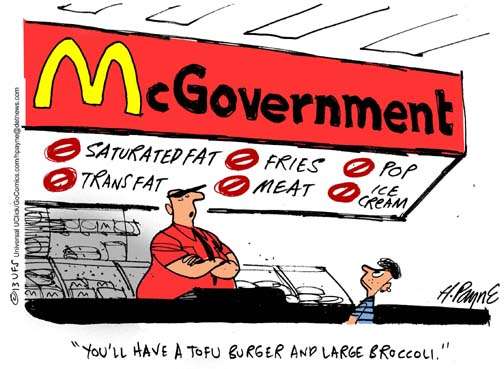
7.) The wider controversy is going to be not over the chart itself, but how far the administration will go to pursue the rapidly expanding agenda of the "food policy" sector. All sorts of nannyish and coercive ideas are emerging from that sector nowadays: proposals at the FDA to limit salt content in processed foods; mandatory calorie labeling, which poses a significant burden on many smaller food vendors and restaurants; new mandates on food served in local schools; advertising bans; and on a local level efforts to ban things like Happy Meals at McDonald's. No wonder many parents, local officials and skeptics in Congress are beginning to say: Back off, guv. It's my plate.
SOURCE
Raw milk mania
The feds recently conducted a year-long sting operation (yes, really.) to arrest an Amish farmer for selling raw milk in DC. Fortunately, raw milk devotees have not allowed this ridiculous law to go unnoticed:
"AMERICA, sleep well. After a year of surveillance, an undercover operation, and a pre-dawn raid by gun-toting U.S. marshals, the country is safe from an Amish farmer. Dan Allgyer’s crime? Selling unpasteurized milk to a food co-op in the Washington area.
But raw-milk advocates, the feds are learning, do not go down easily. About 400 people protesting Mr. Allgyer’s arrest arrived on Capitol Hill earlier this month with a cow named Morgan, a milking stool, plastic cups, and plenty of passion. Toasting their favorite drink, they pointed out that the signers of the Constitution also drank raw milk and proclaimed “the right to choose what to eat and drink” without government interference."
Perhaps one of the reasons this story has managed to get some media attention (despite the obvious factor of an Amish man being arrested) is the complete absurdity of legislating milk.
One of my best professors in college was a progressive with whom I disagreed on…a lot, to put it mildly. He was right, however, when he said that it was always important to consider what would actually happen given a certain legislative outcome, as opposed to what our worst fears for the situation might be.
In this case, were raw milk totally legal (as it has been for most of our nation’s history), what would actually happen is that raw milk fans would keep drinking it, and everyone else would keep avoiding it. It’s not like there’s a giant Amish conspiracy to somehow slip unpasteurized whipping cream onto the shelves of your local Giant without you noticing. These people are not raw milk terrorists:
Moreover, leaving people who like their milk raw alone is not unprecedented - even in the modern developed world:
Throughout Europe, uncooked milk is the norm, dispensed in vending machines in Switzerland, Austria, France, Italy, Slovenia and the Netherlands. It is healthy, adherents say, because it contains fat that is not broken down by homogenization and is free of antibiotics and hormones, because cows are raised in small herds on pastures.
Nutritionist Sylvia Onusic, a raw milk devotee, said heating milk diminishes its taste. “Raw milk is a potential hazardous food, but only in the United States, and I guess Canada, too,” she said. (Raw milk is also banned in Australia and Scotland.) “It’s a totally different food world here. Everything is sterilized and beaten into submission.”
Unlike more polarizing substances such as marijuana and other drugs, it is difficult for me to see why anyone would even consider raw milk a serious threat - let alone organize a sting operation against an Amish farmer for selling it to willing, informed customers.
Moreover, what kind of government outlaws consumption of milk in its natural state? I don’t often use the term “nanny state,” but it’s truly appropriate here. As Ron Paul has put it, “If we are not even free anymore to decide something as basic as what we wish to eat or drink, how much freedom do we really have left?”
If you’ve got a few minutes, maybe give your rep a ring about H.R. 1830, which would legalize the sale of raw milk across state lines, removing federal authority from this totally inappropriate corner of our grocery stores to which it has crept.
SOURCE
Yesterday the USDA and First Lady Michelle Obama unveiled the government's new nutritional chart, which you can check out at the suggestively nannyish URLs MyPlate.gov or ChooseMyPlate.gov ("Please, guv, could you choose my plate? You know best.") It's a sort of segmented cafeteria dish with unequal compartments, slightly larger for "vegetables" and "grains," slightly smaller for "fruits" and "protein," along with a "dairy" circle on the side. A few thoughts:
1.) They seem to have skipped the whole "constitutional authority for the federal government to involve itself in lecturing citizens on what to eat" section. Could it be because there is no such obvious source of authority?
2.) Given that the government has been coming out with these charts for decades, this one is admittedly easier to understand than the awful "pyramid" that came before. Pretty much any graphic they tried — even one based on a Jackson Pollock painting — would have been an improvement on that darn pyramid.
[pullquote]They seem to have skipped the whole 'constitutional authority for the federal government to involve itself in lecturing citizens on what to eat' section.[/pullqupte]
3.) There's a subliminal sort of cleverness to the chart which may offer insight into the Obama administration's thinking. It manages not to mention meat, for instance. It makes "dairy" a little blue circle so you think of nonfat milk or yogurt instead of, say, melted cheese. There's no dessert plate at all — this is the pie chart that doesn't want you to eat pie. There's also no mention of sugar or calories on the graphic, apparently on the theory that if people don't see those things on a government chart, they'll forget they like them.
4.) While clever, it's also a bit incoherent: along with food groups like grains and veggies, there appears a slice for "protein," even though there's protein in grains, dairy and so forth.
5.) Like all such recommendations out of Washington, including earlier versions that did more to push cheese and starch options, this one came out of negotiations that reflected input from farm and producer interest groups. Just something to remember before taking nutrition advice from the federal government, especially since that nutritional advice has often been wrong in the past.
6.) Accompanying the chart is a series of confidently dished-out advice tips on various other nutritional matters, such as "Enjoy your food, but eat less," "Switch to fat-free or lowfat (1%) milk," and "Choose the foods with lower [salt content]." Confident though these may be, these are simply wrong, at least if indiscriminately applied to anyone and everyone. Not all of us struggle with obesity or high blood pressure; some of us, in fact, including some who are elderly or infirm, should be encouraged to get all the calories we need. Serving kids nonfat milk is not an unambiguously good choice if it means they will choose to drink less milk. A recent study in the Journal of the American Medical Association suggested that low-salt diets may pose their own health risks. For that matter, some people — some whole national cuisines, in fact — manage to take in an adequate nutritional balance while dispensing entirely or nearly so with categories like dairy or fruit.
7.) The wider controversy is going to be not over the chart itself, but how far the administration will go to pursue the rapidly expanding agenda of the "food policy" sector. All sorts of nannyish and coercive ideas are emerging from that sector nowadays: proposals at the FDA to limit salt content in processed foods; mandatory calorie labeling, which poses a significant burden on many smaller food vendors and restaurants; new mandates on food served in local schools; advertising bans; and on a local level efforts to ban things like Happy Meals at McDonald's. No wonder many parents, local officials and skeptics in Congress are beginning to say: Back off, guv. It's my plate.
SOURCE
Raw milk mania
The feds recently conducted a year-long sting operation (yes, really.) to arrest an Amish farmer for selling raw milk in DC. Fortunately, raw milk devotees have not allowed this ridiculous law to go unnoticed:
"AMERICA, sleep well. After a year of surveillance, an undercover operation, and a pre-dawn raid by gun-toting U.S. marshals, the country is safe from an Amish farmer. Dan Allgyer’s crime? Selling unpasteurized milk to a food co-op in the Washington area.
But raw-milk advocates, the feds are learning, do not go down easily. About 400 people protesting Mr. Allgyer’s arrest arrived on Capitol Hill earlier this month with a cow named Morgan, a milking stool, plastic cups, and plenty of passion. Toasting their favorite drink, they pointed out that the signers of the Constitution also drank raw milk and proclaimed “the right to choose what to eat and drink” without government interference."
Perhaps one of the reasons this story has managed to get some media attention (despite the obvious factor of an Amish man being arrested) is the complete absurdity of legislating milk.
One of my best professors in college was a progressive with whom I disagreed on…a lot, to put it mildly. He was right, however, when he said that it was always important to consider what would actually happen given a certain legislative outcome, as opposed to what our worst fears for the situation might be.
In this case, were raw milk totally legal (as it has been for most of our nation’s history), what would actually happen is that raw milk fans would keep drinking it, and everyone else would keep avoiding it. It’s not like there’s a giant Amish conspiracy to somehow slip unpasteurized whipping cream onto the shelves of your local Giant without you noticing. These people are not raw milk terrorists:
Moreover, leaving people who like their milk raw alone is not unprecedented - even in the modern developed world:
Throughout Europe, uncooked milk is the norm, dispensed in vending machines in Switzerland, Austria, France, Italy, Slovenia and the Netherlands. It is healthy, adherents say, because it contains fat that is not broken down by homogenization and is free of antibiotics and hormones, because cows are raised in small herds on pastures.
Nutritionist Sylvia Onusic, a raw milk devotee, said heating milk diminishes its taste. “Raw milk is a potential hazardous food, but only in the United States, and I guess Canada, too,” she said. (Raw milk is also banned in Australia and Scotland.) “It’s a totally different food world here. Everything is sterilized and beaten into submission.”
Unlike more polarizing substances such as marijuana and other drugs, it is difficult for me to see why anyone would even consider raw milk a serious threat - let alone organize a sting operation against an Amish farmer for selling it to willing, informed customers.
Moreover, what kind of government outlaws consumption of milk in its natural state? I don’t often use the term “nanny state,” but it’s truly appropriate here. As Ron Paul has put it, “If we are not even free anymore to decide something as basic as what we wish to eat or drink, how much freedom do we really have left?”
If you’ve got a few minutes, maybe give your rep a ring about H.R. 1830, which would legalize the sale of raw milk across state lines, removing federal authority from this totally inappropriate corner of our grocery stores to which it has crept.
SOURCE
Thursday, June 09, 2011
"Good" food improves exam results?
That the definition of "healthy" food was eccentic below (are "local" foods really better for you?) suggests that we are just seeing a "Hawthorne" effect here -- or, more generally, a placebo effect. It's the attention and enthusiasm that has an effect, not the food. No double blind controls, it would seem.
Obese children eating unhealthy food are more likely to have poor exam results, an experiment has revealed. Researchers found that school children eating good food at lunchtime are four times more likely to concentrate in the afternoon.
This led to pupils' exam marks showing a massive improvement with inspection rates by education watchdog Ofsted soaring.
Nearly 4,000 schools took part in the Food For Life Partnership (FFLP). The research, which was carried out by a team from the University of the West of England, also revealed that pupils' interest in healthy foods had an effect on their eating habits at home and their parents' shopping habits.
It found that serving fresh food instead of harmful fats found in biscuits, burgers and cakes had a quick effect on pupils' academic achievement and behaviour. Emma Noble, director of FFLP, said: 'This is carrying on the healthy eating project in schools started by Jamie Oliver but this is a longer term project looking at what young people eat in and out of school. 'Very quickly they found that serving a child good food at lunchtime makes them four times more likely to concentrate in the afternoon,' according to the Sunday Express.
Many of the schools involved in the project set up their own gardens. And it was discovered that children would enjoy eating vegetables they had grown themselves - despite normally turning their noses up at them.
Ian Nurser, headteacher of St Peter’s Church of England School in Wem, Shropshire, said results at his school had been boosted since the schoolchildren started eating healthier meals each day. 'They are very proud of knowing what they should be eating and take a great interest in putting together a healthy meal each day. 'They all learn about links to local produce and really think about things. Our results have steadily improved since we started this project.
'What pupils are learning in the garden and how to cook to a high level are life skills not available to most young people, with 12 per cent of value added in terms of boosted results.'
Libby Grundy, FFLP director, said that despite being pleased with the results of the experiment, she was concerned that cuts to local authority school meal budgets could see more unhealthy ready meals in schools. She said: 'With one in 10 children classed as obese just as the programme looks as if it has reached the tipping point, cuts to school meal budgets could undo all the good work.'
SOURCE
'A significant step forward' in the fight against Alzheimer's: Mad cow disease drug found to block onset of dementia
A drug used to fight mad cow disease could offer hope of a significant breakthrough in the treatment of Alzheimer's. Two of the antibodies in medication for Creutzfeldt-Jakob Disease block the onset of the most common cause of dementia, scientists have discovered. The unexpected findings came as they were developing treatments for CJD.
In a 'significant step forward' in the battle against Alzheimer's, it was found that the antibodies prevent a rogue protein called amyloid beta from gathering in the brain and damaging nerve cells.
The findings, published in the journal Nature Communications, revealed that antibodies ICS-18 and ICSM-35 help to preserve brain function and prevent memory loss, the symptom which most characterises the devastating impact of Alzheimer's.
Lead researcher Professor John Collinge, from University College London, said: 'We're thrilled that this discovery shows in mice that these two antibodies which we are developing to treat CJD may also have a role in treating more common forms of dementia like Alzheimer's disease.
'If these antibody drugs prove to be safe in use to treat CJD we will consider whether studies in Alzheimer's disease should be carried out.'
Professor Dominic Walsh, a co-author of the study from University College Dublin, said: 'A unique aspect of this study is that we used amyloid beta extracted from human brain, the same material we believe is causing memory loss in patients with this devastating disease and we identified two antibodies that could block this effect.
'The use of these specific antibodies is particularly exciting since they have already undergone extensive pre-clinical testing for use in treating CJD. 'Thus a lot of basic work has already been done and could fast-track these antibodies for use in humans. The next step is further validation in other disease models of Alzheimer's and then safety trials in humans.'
Trials of drugs developed from these studies start on patients with CJD next year but could now be fast-tracked for Alzheimer’s sufferers.
Meanwhile, a brain scan that can detect Alzheimer's years in advance could be available within 12 months. PET scans that show the early stages of Alzheimer's disease by detecting beta amyloid should be widely available by next year, scientists announced yesterday.
SOURCE
That the definition of "healthy" food was eccentic below (are "local" foods really better for you?) suggests that we are just seeing a "Hawthorne" effect here -- or, more generally, a placebo effect. It's the attention and enthusiasm that has an effect, not the food. No double blind controls, it would seem.
Obese children eating unhealthy food are more likely to have poor exam results, an experiment has revealed. Researchers found that school children eating good food at lunchtime are four times more likely to concentrate in the afternoon.
This led to pupils' exam marks showing a massive improvement with inspection rates by education watchdog Ofsted soaring.
Nearly 4,000 schools took part in the Food For Life Partnership (FFLP). The research, which was carried out by a team from the University of the West of England, also revealed that pupils' interest in healthy foods had an effect on their eating habits at home and their parents' shopping habits.
It found that serving fresh food instead of harmful fats found in biscuits, burgers and cakes had a quick effect on pupils' academic achievement and behaviour. Emma Noble, director of FFLP, said: 'This is carrying on the healthy eating project in schools started by Jamie Oliver but this is a longer term project looking at what young people eat in and out of school. 'Very quickly they found that serving a child good food at lunchtime makes them four times more likely to concentrate in the afternoon,' according to the Sunday Express.
Many of the schools involved in the project set up their own gardens. And it was discovered that children would enjoy eating vegetables they had grown themselves - despite normally turning their noses up at them.
Ian Nurser, headteacher of St Peter’s Church of England School in Wem, Shropshire, said results at his school had been boosted since the schoolchildren started eating healthier meals each day. 'They are very proud of knowing what they should be eating and take a great interest in putting together a healthy meal each day. 'They all learn about links to local produce and really think about things. Our results have steadily improved since we started this project.
'What pupils are learning in the garden and how to cook to a high level are life skills not available to most young people, with 12 per cent of value added in terms of boosted results.'
Libby Grundy, FFLP director, said that despite being pleased with the results of the experiment, she was concerned that cuts to local authority school meal budgets could see more unhealthy ready meals in schools. She said: 'With one in 10 children classed as obese just as the programme looks as if it has reached the tipping point, cuts to school meal budgets could undo all the good work.'
SOURCE
'A significant step forward' in the fight against Alzheimer's: Mad cow disease drug found to block onset of dementia
A drug used to fight mad cow disease could offer hope of a significant breakthrough in the treatment of Alzheimer's. Two of the antibodies in medication for Creutzfeldt-Jakob Disease block the onset of the most common cause of dementia, scientists have discovered. The unexpected findings came as they were developing treatments for CJD.
In a 'significant step forward' in the battle against Alzheimer's, it was found that the antibodies prevent a rogue protein called amyloid beta from gathering in the brain and damaging nerve cells.
The findings, published in the journal Nature Communications, revealed that antibodies ICS-18 and ICSM-35 help to preserve brain function and prevent memory loss, the symptom which most characterises the devastating impact of Alzheimer's.
Lead researcher Professor John Collinge, from University College London, said: 'We're thrilled that this discovery shows in mice that these two antibodies which we are developing to treat CJD may also have a role in treating more common forms of dementia like Alzheimer's disease.
'If these antibody drugs prove to be safe in use to treat CJD we will consider whether studies in Alzheimer's disease should be carried out.'
Professor Dominic Walsh, a co-author of the study from University College Dublin, said: 'A unique aspect of this study is that we used amyloid beta extracted from human brain, the same material we believe is causing memory loss in patients with this devastating disease and we identified two antibodies that could block this effect.
'The use of these specific antibodies is particularly exciting since they have already undergone extensive pre-clinical testing for use in treating CJD. 'Thus a lot of basic work has already been done and could fast-track these antibodies for use in humans. The next step is further validation in other disease models of Alzheimer's and then safety trials in humans.'
Trials of drugs developed from these studies start on patients with CJD next year but could now be fast-tracked for Alzheimer’s sufferers.
Meanwhile, a brain scan that can detect Alzheimer's years in advance could be available within 12 months. PET scans that show the early stages of Alzheimer's disease by detecting beta amyloid should be widely available by next year, scientists announced yesterday.
SOURCE
Wednesday, June 08, 2011
USDA Spending $10 Million to Promote Farmers' Markets in Michelle Obama's 'Food Deserts'
The heading above is as it appears on the blurb below. It is very precisely worded. It omits any claim that there ARE any food deserts. It just refers to places that are claimed by Mrs Obama to be food deserts. The entire concept of food deserts is just another bit of Leftist mythology that had being dying out until Mrs O revived it.
In urban areas people can always buy food somewhere near where they live -- though not perhaps food approved of by the elites. Even fruit and vegetables are more available than is sometimes claimed. When a particular "food desert" is closely examined, it will usually be found to have small shops run by Koreans, Indians, Hispanics etc that do sell the fruits and vegetables that are in demand among their clientele.
Mrs O, however, seems to have transmogrified the concept of a food desert into the absence of a supermarket, showing a grasp of reality that is every bit as shallow as her husband's. I guess we shouldn't laugh. The idea that supermarkets are a source of fresh food is just supermarket propaganda. Some fruits and vegetables keep well in cold storage and apples (for instance) on sale in a supermarket can be a year or so old!
The U.S Agriculture Department is offering $10 million in grants -- twice as much as last year -- to promote farmer's markets, roadside stands and other healthy food outlets across the country.
The priority this year is to bring fresh food to people living in rural and urban "food deserts," a concept advanced by First Lady Michelle Obama. Food deserts are defined as areas with limited access to affordable and nutritious food, particularly those composed of predominantly lower-income neighborhoods and communities.
Deputy Agriculture Secretary Kathleen Merrigan announced the availability of the taxpayer-funded farmers' market grants last Friday, at the opening of the 2011 USDA Farmer's Market in Washington.
The Farmers' Market Promotion Program [3] (FMPP) funds projects that "contribute to the economic and physical health of communities around the country," the USDA says. The goal is to “increase domestic consumption of agricultural commodities” by improving and expanding farmers markets, or creating new ones.
Merrigan singled out a small farmers' market in Cleveland, Mississippi, which is using an FMPP grant to develop a market on two donated acres.
"The project is also teaching students production skills and entrepreneurship, and providing community members with freezing, canning, and pickling techniques to preserve the harvest for year-round healthy eating," the USDA said. "Upgrades to market equipment and promotions supported by FMPP, along with increased production, have drawn in more vendors (up 57 percent), more customers (up 44 percent), and expanded the market season on both ends (spring and fall)."
Last year, Michelle Obama called on Congress to create a $400 million-a-year program to encourage the establishment of supermarkets in places she called “food deserts.” As CNSNews.com previously reported, Mrs. Obama -- in a March 10, 2010 speech -- described food deserts as areas without a supermarket where "families wind up buying their groceries at the local gas station or convenience store, places that offer few, if any, healthy options.”
She gave the speech one month after launching her "Let's Move" campaign to end childhood obesity in the United States.
The Farmers Market Promotion Program was created during the George W. Bush administration, through a 2002 amendment to a 1976 law. But this year's focus on "food deserts" is new.
The USDA says a total of $14.5 million in grants was awarded for the Farmers Market Promotion Program between 2006 and 2009. Approximately $5 million was allocated for 81 grants in Fiscal Year 2010, while $10 million has been allocated for each of Fiscal Years 2011 and 2012.
The money is to be spent on the marketing and promotion of farmers markets; consumer education and outreach; equipment purchase; transportation and delivery; training farmers in business planning and record-keeping; or waste management and "green technologies."
The application process to obtain an FMPP grant "takes energy and organization," the USDA's Agriculture Marketing Service says. In fact, the guidelines explaining how to apply for an FMPP grant total 43 pages.
SOURCE
An apple a day keeps the doctor away... as long as you eat the peel
And if you are a mouse or a fruit fly
An apple a day really could keep the doctor away – as long as you don’t throw away the peel. The chemical behind the apple skin’s waxy shine is being credited with a host of health benefits from building muscle to keeping the lid on weight.
Ursolic acid also keeps cholesterol and blood sugar under control, meaning an apple a day could do wonders for all-round health.
Researcher Christopher Adams said: ‘Ursolic acid is an interesting natural compound. It’s part of a normal diet as a component of apple peels. ‘They always say that an apple a day keeps the doctor away…’
The importance of apple peel was discovered after Dr Adams, a U.S. expert in how hormones affect the body, set out to find a drug that stops muscles from wasting, keeping pensioners strong as they age and cutting their risk of hard-to-heal fractures.
He said: ‘Muscle wasting is a frequent companion of illness and ageing. ‘It prolongs hospitalisation, delays recoveries and in some cases prevents people from going back home. It isn’t well understood and there’s no medicine for it.’
In order to remedy the situation, Dr Adams, of the University of Iowa, studied the genetic changes that occur when muscles waste or atrophy. He checked a pool of 1,300 chemicals for one that would counter the changes – and hit on ursolic acid.
The researcher then supplemented a normal diet in mice with small amounts of the compound and subjected them to a battery of health tests. The creatures’ muscles got bigger and their grip became stronger.
The benefits didn’t end there. The mice fed the apple peel chemical had lower levels of cholesterol and other blood fats blamed for clogging up the arteries and damaging the heart, and had around a third less body fat.
It is thought that ursolic acid enhances the effects of insulin and insulin-like growth factor 1, two hormones key to muscle growth. It is particularly concentrated in apple peel but is also found in cranberries and prunes and in basil, oregano and thyme.Dr Adams said: ‘We know that if you eat a balanced diet like mom told us to eat you get this material. People who eat junk food don’t get this.’
He added that the goal is to establish whether apple peel is as good for humans as it is for mice – and work out how many apples we might need to help make muscles bulge and waistlines shrink.
If large amounts of ursolic acid are required, it is likely that people will have to take it in concentrated form, either as a supplement or a drug.
Reporting his findings in the journal Cell Metabolism, Dr Adams said: ‘Given the current lack of therapies for muscle atrophy, we speculate that ursolic acid might be investigated as a potential therapy for illness-related and age-related muscle atrophy.’ Obesity and diabetes might also be in its grasp, he added.
Other recent research has credited an apple a day with keeping the undertaker away – at least in flies. Fruit flies given an apple extract lived 10 per cent longer and found it easier to walk, climb and move about as they aged.
Researchers who questioned women about their diets found that those who regularly ate apples were around 20 per cent less likely to suffer heart attacks and strokes.
SOURCE
The heading above is as it appears on the blurb below. It is very precisely worded. It omits any claim that there ARE any food deserts. It just refers to places that are claimed by Mrs Obama to be food deserts. The entire concept of food deserts is just another bit of Leftist mythology that had being dying out until Mrs O revived it.
In urban areas people can always buy food somewhere near where they live -- though not perhaps food approved of by the elites. Even fruit and vegetables are more available than is sometimes claimed. When a particular "food desert" is closely examined, it will usually be found to have small shops run by Koreans, Indians, Hispanics etc that do sell the fruits and vegetables that are in demand among their clientele.
Mrs O, however, seems to have transmogrified the concept of a food desert into the absence of a supermarket, showing a grasp of reality that is every bit as shallow as her husband's. I guess we shouldn't laugh. The idea that supermarkets are a source of fresh food is just supermarket propaganda. Some fruits and vegetables keep well in cold storage and apples (for instance) on sale in a supermarket can be a year or so old!
The U.S Agriculture Department is offering $10 million in grants -- twice as much as last year -- to promote farmer's markets, roadside stands and other healthy food outlets across the country.
The priority this year is to bring fresh food to people living in rural and urban "food deserts," a concept advanced by First Lady Michelle Obama. Food deserts are defined as areas with limited access to affordable and nutritious food, particularly those composed of predominantly lower-income neighborhoods and communities.
Deputy Agriculture Secretary Kathleen Merrigan announced the availability of the taxpayer-funded farmers' market grants last Friday, at the opening of the 2011 USDA Farmer's Market in Washington.
The Farmers' Market Promotion Program [3] (FMPP) funds projects that "contribute to the economic and physical health of communities around the country," the USDA says. The goal is to “increase domestic consumption of agricultural commodities” by improving and expanding farmers markets, or creating new ones.
Merrigan singled out a small farmers' market in Cleveland, Mississippi, which is using an FMPP grant to develop a market on two donated acres.
"The project is also teaching students production skills and entrepreneurship, and providing community members with freezing, canning, and pickling techniques to preserve the harvest for year-round healthy eating," the USDA said. "Upgrades to market equipment and promotions supported by FMPP, along with increased production, have drawn in more vendors (up 57 percent), more customers (up 44 percent), and expanded the market season on both ends (spring and fall)."
Last year, Michelle Obama called on Congress to create a $400 million-a-year program to encourage the establishment of supermarkets in places she called “food deserts.” As CNSNews.com previously reported, Mrs. Obama -- in a March 10, 2010 speech -- described food deserts as areas without a supermarket where "families wind up buying their groceries at the local gas station or convenience store, places that offer few, if any, healthy options.”
She gave the speech one month after launching her "Let's Move" campaign to end childhood obesity in the United States.
The Farmers Market Promotion Program was created during the George W. Bush administration, through a 2002 amendment to a 1976 law. But this year's focus on "food deserts" is new.
The USDA says a total of $14.5 million in grants was awarded for the Farmers Market Promotion Program between 2006 and 2009. Approximately $5 million was allocated for 81 grants in Fiscal Year 2010, while $10 million has been allocated for each of Fiscal Years 2011 and 2012.
The money is to be spent on the marketing and promotion of farmers markets; consumer education and outreach; equipment purchase; transportation and delivery; training farmers in business planning and record-keeping; or waste management and "green technologies."
The application process to obtain an FMPP grant "takes energy and organization," the USDA's Agriculture Marketing Service says. In fact, the guidelines explaining how to apply for an FMPP grant total 43 pages.
SOURCE
An apple a day keeps the doctor away... as long as you eat the peel
And if you are a mouse or a fruit fly
An apple a day really could keep the doctor away – as long as you don’t throw away the peel. The chemical behind the apple skin’s waxy shine is being credited with a host of health benefits from building muscle to keeping the lid on weight.
Ursolic acid also keeps cholesterol and blood sugar under control, meaning an apple a day could do wonders for all-round health.
Researcher Christopher Adams said: ‘Ursolic acid is an interesting natural compound. It’s part of a normal diet as a component of apple peels. ‘They always say that an apple a day keeps the doctor away…’
The importance of apple peel was discovered after Dr Adams, a U.S. expert in how hormones affect the body, set out to find a drug that stops muscles from wasting, keeping pensioners strong as they age and cutting their risk of hard-to-heal fractures.
He said: ‘Muscle wasting is a frequent companion of illness and ageing. ‘It prolongs hospitalisation, delays recoveries and in some cases prevents people from going back home. It isn’t well understood and there’s no medicine for it.’
In order to remedy the situation, Dr Adams, of the University of Iowa, studied the genetic changes that occur when muscles waste or atrophy. He checked a pool of 1,300 chemicals for one that would counter the changes – and hit on ursolic acid.
The researcher then supplemented a normal diet in mice with small amounts of the compound and subjected them to a battery of health tests. The creatures’ muscles got bigger and their grip became stronger.
The benefits didn’t end there. The mice fed the apple peel chemical had lower levels of cholesterol and other blood fats blamed for clogging up the arteries and damaging the heart, and had around a third less body fat.
It is thought that ursolic acid enhances the effects of insulin and insulin-like growth factor 1, two hormones key to muscle growth. It is particularly concentrated in apple peel but is also found in cranberries and prunes and in basil, oregano and thyme.Dr Adams said: ‘We know that if you eat a balanced diet like mom told us to eat you get this material. People who eat junk food don’t get this.’
He added that the goal is to establish whether apple peel is as good for humans as it is for mice – and work out how many apples we might need to help make muscles bulge and waistlines shrink.
If large amounts of ursolic acid are required, it is likely that people will have to take it in concentrated form, either as a supplement or a drug.
Reporting his findings in the journal Cell Metabolism, Dr Adams said: ‘Given the current lack of therapies for muscle atrophy, we speculate that ursolic acid might be investigated as a potential therapy for illness-related and age-related muscle atrophy.’ Obesity and diabetes might also be in its grasp, he added.
Other recent research has credited an apple a day with keeping the undertaker away – at least in flies. Fruit flies given an apple extract lived 10 per cent longer and found it easier to walk, climb and move about as they aged.
Researchers who questioned women about their diets found that those who regularly ate apples were around 20 per cent less likely to suffer heart attacks and strokes.
SOURCE
Tuesday, June 07, 2011
For once Obama sets a good example -- ignores food freaks
As Kevin reported earlier this week, the USDA got rid of the food pyramid and replaced it with a food plate, a cost of millions to the taxpayer, so people can better understand how to feed themselves.
Shortly after the new and improved plate was released, President Obama chowed down on what his wife, Michelle, probably wouldn't approve of: Chili dogs...two of them.
SOURCE
Make mine a Subway: Turkey sandwich diet helps British father-of-two lose five stones

A fast food fan has lost a staggering five stone in nine months by eating nothing but Subway sandwiches. Carsten Renken, 41, ditched his diet of burgers, fried chicken and microwave meals after doctors warned him that he was dangerously overweight.
He made the unusual decision to eat nothing but six-inch club sandwiches filled with turkey, ham, beef and salad for lunch and dinner. Each sandwich contains 298 calories.
Mr Renken has managed to drop from 16st 8lbs [224lb] last September to 11st [154lb] today. Meanwhile his waistline shrank from 44in to 31in.
The father-of-two from Coventry, said: 'I live a busy life so convenience was the only option, but I've found a fast food that works for me. 'I couldn't face totally giving up fast food. We all have our vices and this is mine.
'I like Subway sandwiches but it's important that people know I'm totally independent of the chain. I'm not doing this for money or free Subs. I'm doing this because obesity is a growing problem and I want to share my success story with everyone. 'I want people to know that although fast food can cause the problem, it can be your way out of it too.'
The father-of-two used to consume up to 5,000 calories per day - almost twice the recommended daily allowance for men. But he knew it was time to tackle his spiraling weight during a holiday in Sweden when his 13-year-old daughter said he was the fattest man at the resort.
Mr Renken's breakfast used to consist of a double sausage and egg McMuffin with a substantial side-order of hash browns and fries.
Lunch would be a feast of KFC fillet tower burgers or two double-bacon cheeseburgers from Burger King.
For dinner, he would munch on fatty microwave meals or indulge in large greasy portions of chips from the local chippy.
But Mr Renken is now on 'first name terms' with staff at his local Subway branch in Coventry.
Store manager David Rollason, 25, said: 'Carsten has been coming here for so many months now and we always know what his order will be. 'We're his local Subway and he knows the service is quick. He has become a very familiar face and we always enjoy a bit of banter with each other. 'When he first started coming here, he was very overweight, but when you line up a picture of him now with one of him then, the difference is amazing. 'His weight loss has been so dramatic.'
Kathy Cowbrough, Dietitian and Public Health Nutritionist, said: ‘What Mr Renken has done is what most people need to do to lose weight - cut the amount he is eating by controlling his portions. For him it’s made easy by having the same thing every day where he knows how that he is consuming 1,100 calories a day.
‘For weight loss depending on a person's energy needs we recommend a deficit of 500 calories per day and aim for around 1200-1500 calories.
‘However, it would be worth him keeping a food diary and comparing it with the Eatwell plate as this gives guidance on proportions of food groups to eat to give the body the nutrients it needs. This way he can make sure he is not missing out on any crucial food groups.’
SOURCE
As Kevin reported earlier this week, the USDA got rid of the food pyramid and replaced it with a food plate, a cost of millions to the taxpayer, so people can better understand how to feed themselves.
Shortly after the new and improved plate was released, President Obama chowed down on what his wife, Michelle, probably wouldn't approve of: Chili dogs...two of them.
When his wife unveiled the USDA's new nutritional plate yesterday, there definitely wasn't a space for chili dogs.
But that didn't stop Barack Obama wolfing down two in Toledo today - with fries and an extra bowl of chili on the side.
The president happily munched on the unhealthy meal before he visited the city's Chrysler factory, and even teased one of his hosts for ordering ketchup, a faux-pas in his home town of Chicago.
Yesterday she unveiled the USDA's new healthy-eating guide, which replaces the famous 'My Pyramid' with a plate divided into four nutritional quadrants: fruits, vegetables, grains and proteins.
But as her husband chowed down at the famous Rudy's Hot Dog with Toledo's mayor, the only sign of 'vegetables' appeared to be some fried onions.
He ordered the house speciality chili dog, which comes with mustard, onion, chili sauce and cheese, and topped it up with a bowl of chili and a portion of fries on the side.
SOURCE
Make mine a Subway: Turkey sandwich diet helps British father-of-two lose five stones
A fast food fan has lost a staggering five stone in nine months by eating nothing but Subway sandwiches. Carsten Renken, 41, ditched his diet of burgers, fried chicken and microwave meals after doctors warned him that he was dangerously overweight.
He made the unusual decision to eat nothing but six-inch club sandwiches filled with turkey, ham, beef and salad for lunch and dinner. Each sandwich contains 298 calories.
Mr Renken has managed to drop from 16st 8lbs [224lb] last September to 11st [154lb] today. Meanwhile his waistline shrank from 44in to 31in.
The father-of-two from Coventry, said: 'I live a busy life so convenience was the only option, but I've found a fast food that works for me. 'I couldn't face totally giving up fast food. We all have our vices and this is mine.
'I like Subway sandwiches but it's important that people know I'm totally independent of the chain. I'm not doing this for money or free Subs. I'm doing this because obesity is a growing problem and I want to share my success story with everyone. 'I want people to know that although fast food can cause the problem, it can be your way out of it too.'
The father-of-two used to consume up to 5,000 calories per day - almost twice the recommended daily allowance for men. But he knew it was time to tackle his spiraling weight during a holiday in Sweden when his 13-year-old daughter said he was the fattest man at the resort.
Mr Renken's breakfast used to consist of a double sausage and egg McMuffin with a substantial side-order of hash browns and fries.
Lunch would be a feast of KFC fillet tower burgers or two double-bacon cheeseburgers from Burger King.
For dinner, he would munch on fatty microwave meals or indulge in large greasy portions of chips from the local chippy.
But Mr Renken is now on 'first name terms' with staff at his local Subway branch in Coventry.
Store manager David Rollason, 25, said: 'Carsten has been coming here for so many months now and we always know what his order will be. 'We're his local Subway and he knows the service is quick. He has become a very familiar face and we always enjoy a bit of banter with each other. 'When he first started coming here, he was very overweight, but when you line up a picture of him now with one of him then, the difference is amazing. 'His weight loss has been so dramatic.'
Kathy Cowbrough, Dietitian and Public Health Nutritionist, said: ‘What Mr Renken has done is what most people need to do to lose weight - cut the amount he is eating by controlling his portions. For him it’s made easy by having the same thing every day where he knows how that he is consuming 1,100 calories a day.
‘For weight loss depending on a person's energy needs we recommend a deficit of 500 calories per day and aim for around 1200-1500 calories.
‘However, it would be worth him keeping a food diary and comparing it with the Eatwell plate as this gives guidance on proportions of food groups to eat to give the body the nutrients it needs. This way he can make sure he is not missing out on any crucial food groups.’
SOURCE
Monday, June 06, 2011
Stressed at the office? Break out the pomegranate juice - it will make you more enthusiastic about your job
This would seem to be just corporate puffery -- research NOT done under double blind conditions. That the stuff contains anti-oxidants is a concern though, considering the evidence that such molecules SHORTEN your life
Pomegranate juice could help beat stress at the office, research claims. It has been shown to lower workers' heart rates and make them feel more enthusiastic about their jobs.
Scientists studied a group of volunteers who drank 500ml of the juice every day for two weeks. At the beginning and end of the study their pulse rate was measured and they filled in a questionnaire describing their mood and feelings about their job.
The research – funded by the Pomegreat juice company – showed almost all of the workers reported being more enthusiastic, inspired, proud and active. They were less likely to describe their feelings as distressed, nervous, guilty and ashamed compared with the beginning of the fortnight and most had lower pulse rates.
Experts claim increasing numbers of Britons are affected by work-related pressures. Figures from the charity Mind show around a fifth of employees called in sick at some point last year as they were stressed.
Lead researcher Dr Emad Al-Dujaili, of Queen Margaret University in Edinburgh, said: 'On the basis of these findings there is a justified argument for busy workers to drink pomegranate juice to help alleviate chronic stress and maintain good health.
'There is growing evidence that pomegranate juice delivers wide-ranging health benefits that merit further research. 'It is very rare indeed for an all-natural juice to offer the range of health benefits that we are seeing in pomegranate juice.'
Last year the same researchers claimed that pomegranate juice could help to combat middle-aged spread. After just one month, volunteers who drank a bottle of pomegranate juice every day were found to be less likely to develop fatty cells around their abdomen.
They also had lower blood pressure, reducing the risk of heart attacks, strokes and kidney disease. Scientists also claim pomegranate juice can help to fight cancer, heart disease and the aging process. It is high in antioxidants, chemicals which help neutralise harmful oxygen molecules – called free radicals.
SOURCE
Scientists discover 'werewolf' gene which could spell the end for baldness
A 'werewolf' gene which causes hair to grow all over the body has been found by scientists, who say the discovery could lead to a remedy for baldness. They have tracked down a genetic fault which is behind a rare condition called hyper- trichosis, or werewolf syndrome, where thick hair covers the face and upper body. They say they may be able to use drugs to trigger a similar gene mutation in people to encourage hair to grow on bald patches.
But the scientists stressed that tackling baldness was still many years away. They do not yet know how they would be able to trigger hair to grow in bald patches without causing excessive growth all over the body.
Werewolf syndrome is extremely rare, with only 50 recorded cases in the past 300 years. One is Supatra Sasuphan, an 11-year-old girl from Thailand who was named as the world's hairiest child in the Guinness World Records in March.
Men with the condition have hair all over their face, including eyelids, and upper bodies. Women tend to just have hair in patches although Supatra has it covering much of her face.
Scientists from the University of Southern California, working with researchers from Beijing, discovered the gene in a Mexican family and Chinese family who both had the condition – known in the medical world as CGH.
Professor Pragna Patel, of the university's Institute for Genetic Medicine, said certain genes appeared to have been 'turned on', which may trigger the excessive hair growth. In the future, scientists could use drugs to 'turn on' genes, which could trigger hair growth.
Professor Patel added: 'If in fact the inserted sequences turn on a gene that can trigger hair growth, it may hold promise for treating baldness.'
SOURCE
This would seem to be just corporate puffery -- research NOT done under double blind conditions. That the stuff contains anti-oxidants is a concern though, considering the evidence that such molecules SHORTEN your life
Pomegranate juice could help beat stress at the office, research claims. It has been shown to lower workers' heart rates and make them feel more enthusiastic about their jobs.
Scientists studied a group of volunteers who drank 500ml of the juice every day for two weeks. At the beginning and end of the study their pulse rate was measured and they filled in a questionnaire describing their mood and feelings about their job.
The research – funded by the Pomegreat juice company – showed almost all of the workers reported being more enthusiastic, inspired, proud and active. They were less likely to describe their feelings as distressed, nervous, guilty and ashamed compared with the beginning of the fortnight and most had lower pulse rates.
Experts claim increasing numbers of Britons are affected by work-related pressures. Figures from the charity Mind show around a fifth of employees called in sick at some point last year as they were stressed.
Lead researcher Dr Emad Al-Dujaili, of Queen Margaret University in Edinburgh, said: 'On the basis of these findings there is a justified argument for busy workers to drink pomegranate juice to help alleviate chronic stress and maintain good health.
'There is growing evidence that pomegranate juice delivers wide-ranging health benefits that merit further research. 'It is very rare indeed for an all-natural juice to offer the range of health benefits that we are seeing in pomegranate juice.'
Last year the same researchers claimed that pomegranate juice could help to combat middle-aged spread. After just one month, volunteers who drank a bottle of pomegranate juice every day were found to be less likely to develop fatty cells around their abdomen.
They also had lower blood pressure, reducing the risk of heart attacks, strokes and kidney disease. Scientists also claim pomegranate juice can help to fight cancer, heart disease and the aging process. It is high in antioxidants, chemicals which help neutralise harmful oxygen molecules – called free radicals.
SOURCE
Scientists discover 'werewolf' gene which could spell the end for baldness
A 'werewolf' gene which causes hair to grow all over the body has been found by scientists, who say the discovery could lead to a remedy for baldness. They have tracked down a genetic fault which is behind a rare condition called hyper- trichosis, or werewolf syndrome, where thick hair covers the face and upper body. They say they may be able to use drugs to trigger a similar gene mutation in people to encourage hair to grow on bald patches.
But the scientists stressed that tackling baldness was still many years away. They do not yet know how they would be able to trigger hair to grow in bald patches without causing excessive growth all over the body.
Werewolf syndrome is extremely rare, with only 50 recorded cases in the past 300 years. One is Supatra Sasuphan, an 11-year-old girl from Thailand who was named as the world's hairiest child in the Guinness World Records in March.
Men with the condition have hair all over their face, including eyelids, and upper bodies. Women tend to just have hair in patches although Supatra has it covering much of her face.
Scientists from the University of Southern California, working with researchers from Beijing, discovered the gene in a Mexican family and Chinese family who both had the condition – known in the medical world as CGH.
Professor Pragna Patel, of the university's Institute for Genetic Medicine, said certain genes appeared to have been 'turned on', which may trigger the excessive hair growth. In the future, scientists could use drugs to 'turn on' genes, which could trigger hair growth.
Professor Patel added: 'If in fact the inserted sequences turn on a gene that can trigger hair growth, it may hold promise for treating baldness.'
SOURCE
Sunday, June 05, 2011
Most 'wasting money on health supplements' finds NHS report
Interesting and pleasing that both antioxidants and Omega 3 get the thumbs down
Most are wasting money on vitamin pills and other health supplements that do them no good, an NHS report has warned.
The market for dietary supplements and vitamins was worth more than £670 million in 2009, according to NHS Choices, which provides general health information.
But, in a new report titled Supplements: Who needs them? the authors concluded: "During our work it has become clear that the widely perceived benefits of certain supplements simply do not have enough robust evidence to support them."
This was partly due to press coverage, partly due to the way they were marketed, and partly due to "the sheer volume of misinformation floating around on the internet."
The report found that vitamin supplements to be a particular area of wasted cash.
Accounting for almost a third of the overall market, at £208 million, the report stated: "There are clearly plenty of people buying vitamin supplements but, surprisingly, only certain groups are considered to benefit from taking them."
This included those over 65; those with darker skin and those who were not exposed to a lot of sun - who should all take vitamin D supplements - and all children from six months to five years, who should take a multivitamin (A, C and D) supplement.
The authors wrote: "If you fall outside of these groups and buy vitamin pills then the chances are that you will be spending your money on surplus amounts of vitamins you've already gained through your diet."
The jury was still out on antioxidants, it reported, concluding that research indicated "it would seem sensible for most of us to rely on a balanced diet" for our intake of the compounds.
There was "little evidence" that some weight loss products sold by "reputable retailers" worked, while a review of how they were marketed found half breached advertising regulations.
It reported there was also "little evidence" that vitamin C supplements were "beneficial within the general community in terms of preventing infection" from cold viruses, although the authors conceded they did seem to reduce cold duration "a little".
However, there was recent evidence that zinc was effective in fighting cold viruses, although it "may not seem worth the expense" at £35 for a five month supply.
While it is recommended that people who have suffered a heart attack eat two to four portions of oily fish a week, it reported that more trials were needed to "confirm suggestions of a protective effect on cardiovascular health".
Neither was there "compelling evidence" that omega-3 fatty acids helped boost children's brainpower, the report warned.
It concluded: "Overall, it is clear that we may be placing our hope in products that still require far more testing."
SOURCE
Ovarian cancer discovery gives hope to women after biggest breakthrough in two decades
A drug has been hailed as the biggest breakthrough in 20 years of ovarian cancer research after trials showed it can increase patients’ life expectancy by up to eight months.
British researchers found Avastin, which is used to treat breast and bowel cancers, is also effective against ovarian cancer.
The disease has been called the ‘silent killer’ because it often has no symptoms in the early stages and in 80 per cent of cases is not detected until it has spread. Currently, the only treatment is chemotherapy following surgery.
Annwen Jones, chief executive of the charity Target Ovarian Cancer, said: ‘It is the first glimmer of hope that there are significant advancements in treatments for ovarian cancer on the horizon.
'There is a moral imperative to ensure Avastin is fast-tracked through the necessary regulatory processes.’
The research, which was revealed at the American Society of Clinical Oncology’s annual conference yesterday, involved more than 1,500 women across Europe with advanced ovarian cancer.
All had their tumour removed and received chemotherapy, but those also given Avastin, which starves tumours of the blood they need to grow and spread, lived on average 7.8 months longer than the control group.
Lead investigator Dr Charlie Gourley, from the Edinburgh Cancer Research UK Centre, said: ‘We would like to be able to make ovarian cancer a chronic, rather than fatal, disease.’
Roche, which manufactures the drug, has applied to the European Medicines Agency for a licence to use it to treat ovarian cancer, which means it could be available before the end of the year.
It will then need to be approved by the Government’s drugs watchdog NICE before it is widely available. In the meantime, women can apply to the Government’s Cancer Drugs Fund to receive the drug.
SOURCE
Interesting and pleasing that both antioxidants and Omega 3 get the thumbs down
Most are wasting money on vitamin pills and other health supplements that do them no good, an NHS report has warned.
The market for dietary supplements and vitamins was worth more than £670 million in 2009, according to NHS Choices, which provides general health information.
But, in a new report titled Supplements: Who needs them? the authors concluded: "During our work it has become clear that the widely perceived benefits of certain supplements simply do not have enough robust evidence to support them."
This was partly due to press coverage, partly due to the way they were marketed, and partly due to "the sheer volume of misinformation floating around on the internet."
The report found that vitamin supplements to be a particular area of wasted cash.
Accounting for almost a third of the overall market, at £208 million, the report stated: "There are clearly plenty of people buying vitamin supplements but, surprisingly, only certain groups are considered to benefit from taking them."
This included those over 65; those with darker skin and those who were not exposed to a lot of sun - who should all take vitamin D supplements - and all children from six months to five years, who should take a multivitamin (A, C and D) supplement.
The authors wrote: "If you fall outside of these groups and buy vitamin pills then the chances are that you will be spending your money on surplus amounts of vitamins you've already gained through your diet."
The jury was still out on antioxidants, it reported, concluding that research indicated "it would seem sensible for most of us to rely on a balanced diet" for our intake of the compounds.
There was "little evidence" that some weight loss products sold by "reputable retailers" worked, while a review of how they were marketed found half breached advertising regulations.
It reported there was also "little evidence" that vitamin C supplements were "beneficial within the general community in terms of preventing infection" from cold viruses, although the authors conceded they did seem to reduce cold duration "a little".
However, there was recent evidence that zinc was effective in fighting cold viruses, although it "may not seem worth the expense" at £35 for a five month supply.
While it is recommended that people who have suffered a heart attack eat two to four portions of oily fish a week, it reported that more trials were needed to "confirm suggestions of a protective effect on cardiovascular health".
Neither was there "compelling evidence" that omega-3 fatty acids helped boost children's brainpower, the report warned.
It concluded: "Overall, it is clear that we may be placing our hope in products that still require far more testing."
SOURCE
Ovarian cancer discovery gives hope to women after biggest breakthrough in two decades
A drug has been hailed as the biggest breakthrough in 20 years of ovarian cancer research after trials showed it can increase patients’ life expectancy by up to eight months.
British researchers found Avastin, which is used to treat breast and bowel cancers, is also effective against ovarian cancer.
The disease has been called the ‘silent killer’ because it often has no symptoms in the early stages and in 80 per cent of cases is not detected until it has spread. Currently, the only treatment is chemotherapy following surgery.
Annwen Jones, chief executive of the charity Target Ovarian Cancer, said: ‘It is the first glimmer of hope that there are significant advancements in treatments for ovarian cancer on the horizon.
'There is a moral imperative to ensure Avastin is fast-tracked through the necessary regulatory processes.’
The research, which was revealed at the American Society of Clinical Oncology’s annual conference yesterday, involved more than 1,500 women across Europe with advanced ovarian cancer.
All had their tumour removed and received chemotherapy, but those also given Avastin, which starves tumours of the blood they need to grow and spread, lived on average 7.8 months longer than the control group.
Lead investigator Dr Charlie Gourley, from the Edinburgh Cancer Research UK Centre, said: ‘We would like to be able to make ovarian cancer a chronic, rather than fatal, disease.’
Roche, which manufactures the drug, has applied to the European Medicines Agency for a licence to use it to treat ovarian cancer, which means it could be available before the end of the year.
It will then need to be approved by the Government’s drugs watchdog NICE before it is widely available. In the meantime, women can apply to the Government’s Cancer Drugs Fund to receive the drug.
SOURCE
Saturday, June 04, 2011
Eating a high-fat diet during pregnancy 'increases the risk of stillbirth'
If you are a monkey. Humans may be better adapted to such a diet. It's unlikely to be a normal monkey diet
Pregnant women who tuck into fatty foods are at greater risk of having a stillbirth, a study reveals.
Researchers found an unhealthy diet decreased the blood flow from mother to baby via the placenta - the temporary organ that nourishes the foetus.
Previous studies have found nearly all pregnancy complications - from abnormal foetal growth to premature labour - are in some way linked to a damaged placenta.
Scientists at Oregon Health & Science University hypothesised that eating a high-fat diet during pregnancy could also increase the risk of placental inflammation and the risk of stillbirth.
The team studied two dozen pregnant Japanese macaques monkeys, an animal that has a placental structure similar to humans.
Half were given a diet where one third of the calories came from fat while the others were placed on a control diet that had just half that amount.
The researchers found the monkeys that ate a high-fat diet experienced a decrease in blood flow from the uterus to the placenta of up to 56 per cent. They also charted a rise in placental inflammation.
This was the case regardless of whether the monkeys were obese or slender.
Lead investigator Dr Antonio Frias, said: 'This study demonstrates that maternal diet during pregnancy has a profound influence on both placental and fetal development.
'The high-calorie, high-fat diet common in our society has negative effects on placental function and may be a significant contributor to adverse pregnancy outcomes, such as stillbirth.'
Additional studies are needed to determine exactly how a high-fat diet decreases placental blood flow, the researchers said. Future studies also will investigate the impact of dietary changes and diet supplementation on improving outcomes in both monkeys and humans.
The findings were published in the June edition of the journal Endocrinology.
SOURCE
No IVF on the NHS if your husband smokes
This is ideology rather than science. Where is the evidence of harm?
Men whose partners want to get IVF treatment on the NHS are being made to take 'breathalyser' type tests to ensure they do not smoke either. It has been common practice for years for health authorities that pay the bills for NHS patients, to insist that women seeking IVF treatment are not smokers. There is clear evidence that smoking both reduces the chances of a successful implantation and harms the developing baby.
But now primary care trusts (PCTs) are raising the bar, despite there being limited evidence that smoking before conception leads to seriously damaged sperm.
They have started making the requirement this year, said Prof Simon Fishel, managing director of Care Fertility, Britain's biggest private provider of IVF to NHS patients.
He said: "I can understand why the NHS is bringing in this policy, but what must be hard for couples is seeing the man in the street who smokes 50 fags a day, and has six kids."
Male partners are either being mouth-swabbed for evidence of smoking or being asked to blow into a device that measure carbon monoxide (CO) content in exhaled air. It is so sensitive that it picks up CO from just an occasional cigarette. Women are being refused treatment until their partners get a completely clear 'green' signal.
A recent Japanese study, published in the journal Fertility and Sterility, has linked smoking in fathers during their partners' pregnancies with earlier menopause in daughters.
But Prof Fishel said prising apart whether biological damage in children was due to passive smoking during childhood, or damage to sperm and egg DNA caused by parents smoking before conception, was almost impossible. He said the evidence was "not conclusive" that smoking's effect on DNA was powerful enough to cause serious problems in children, although it was clear that smoking did cause potentially harmful 'epigenetic' changes in sperm and eggs.
NHS organisations now insisting on both parents being non-smokers include the East Midlands Specialist Commissioning Group, NHS Yorkshire and Humberside, and NHS South Staffordshire, said a spokesman for Care Fertility.
Susan Seenan, of Infertility Network UK, said: "If they are basing this on medical evidence, than I don't think couples would have an argument with it. "But if they are doing it simply to ration treatment, then that would be wrong."
SOURCE
If you are a monkey. Humans may be better adapted to such a diet. It's unlikely to be a normal monkey diet
Pregnant women who tuck into fatty foods are at greater risk of having a stillbirth, a study reveals.
Researchers found an unhealthy diet decreased the blood flow from mother to baby via the placenta - the temporary organ that nourishes the foetus.
Previous studies have found nearly all pregnancy complications - from abnormal foetal growth to premature labour - are in some way linked to a damaged placenta.
Scientists at Oregon Health & Science University hypothesised that eating a high-fat diet during pregnancy could also increase the risk of placental inflammation and the risk of stillbirth.
The team studied two dozen pregnant Japanese macaques monkeys, an animal that has a placental structure similar to humans.
Half were given a diet where one third of the calories came from fat while the others were placed on a control diet that had just half that amount.
The researchers found the monkeys that ate a high-fat diet experienced a decrease in blood flow from the uterus to the placenta of up to 56 per cent. They also charted a rise in placental inflammation.
This was the case regardless of whether the monkeys were obese or slender.
Lead investigator Dr Antonio Frias, said: 'This study demonstrates that maternal diet during pregnancy has a profound influence on both placental and fetal development.
'The high-calorie, high-fat diet common in our society has negative effects on placental function and may be a significant contributor to adverse pregnancy outcomes, such as stillbirth.'
Additional studies are needed to determine exactly how a high-fat diet decreases placental blood flow, the researchers said. Future studies also will investigate the impact of dietary changes and diet supplementation on improving outcomes in both monkeys and humans.
The findings were published in the June edition of the journal Endocrinology.
SOURCE
No IVF on the NHS if your husband smokes
This is ideology rather than science. Where is the evidence of harm?
Men whose partners want to get IVF treatment on the NHS are being made to take 'breathalyser' type tests to ensure they do not smoke either. It has been common practice for years for health authorities that pay the bills for NHS patients, to insist that women seeking IVF treatment are not smokers. There is clear evidence that smoking both reduces the chances of a successful implantation and harms the developing baby.
But now primary care trusts (PCTs) are raising the bar, despite there being limited evidence that smoking before conception leads to seriously damaged sperm.
They have started making the requirement this year, said Prof Simon Fishel, managing director of Care Fertility, Britain's biggest private provider of IVF to NHS patients.
He said: "I can understand why the NHS is bringing in this policy, but what must be hard for couples is seeing the man in the street who smokes 50 fags a day, and has six kids."
Male partners are either being mouth-swabbed for evidence of smoking or being asked to blow into a device that measure carbon monoxide (CO) content in exhaled air. It is so sensitive that it picks up CO from just an occasional cigarette. Women are being refused treatment until their partners get a completely clear 'green' signal.
A recent Japanese study, published in the journal Fertility and Sterility, has linked smoking in fathers during their partners' pregnancies with earlier menopause in daughters.
But Prof Fishel said prising apart whether biological damage in children was due to passive smoking during childhood, or damage to sperm and egg DNA caused by parents smoking before conception, was almost impossible. He said the evidence was "not conclusive" that smoking's effect on DNA was powerful enough to cause serious problems in children, although it was clear that smoking did cause potentially harmful 'epigenetic' changes in sperm and eggs.
NHS organisations now insisting on both parents being non-smokers include the East Midlands Specialist Commissioning Group, NHS Yorkshire and Humberside, and NHS South Staffordshire, said a spokesman for Care Fertility.
Susan Seenan, of Infertility Network UK, said: "If they are basing this on medical evidence, than I don't think couples would have an argument with it. "But if they are doing it simply to ration treatment, then that would be wrong."
SOURCE
Friday, June 03, 2011
Are mobile phones frying our brains?
Mobile phone danger seems to be a perennial story in the media. I got my first mobile phone before the world wide web had been invented, but I am sure that there must have been people using their Roneo machines to run off fliers warning of the dangers and then attaching them to lamp posts with sticky tape.
I remember seeing someone very concerned about mobile phone radiation danger using a hands-free earpiece. All very safe against brain cancer, but he had the handset sitting in his lap. I thought at the time that he hadn't thought things through very well. Part of the problem is that a large number of people don't think things through very well.
Let's start off by looking at how the spectrum of electromagnetic radiation is made up. Shorter wavelengths mean higher energy and it is generally accepted that cancer caused by DNA disruption requires wavelengths less than that of visible light. Above ultra-violet the photons simply do not possess the necessary energy.
While everyone is in agreement about shorter wavelengths, concerns about longer wavelengths are selective. Remember that all electromagnetic radiation is the same thing - it only varies in wavelength and frequency (they go together - you can't change one without changing the other).
People worried about electromagnetic radiation seem to be quite happy with the visible part of the spectrum, although it is always a nice joke to ask the most strident "we don't need any EMF here" campaigners if they really are opposed to all wavelengths and frequencies.
Above visible light there seem to be several spectrum bands which cause concern. Nobody seems too worried by the television and broadcast radio signals which fill the air around us. While they might be pushed out by quite high-powered transmitters there doesn't seem to be any incentive for scaremongers to frighten people, or perhaps they realise that arguing for the elimination of television might be a hard sell.
Then there are microwaves, low-frequency emissions from power lines, low-power communication such as WiFi and Bluetooth, and the big one, mobile phones.
Everyone has seen how a microwave oven heats things quickly and has mandatory safety features to keep the waves inside. Most people, however, are happy to accept that the radiation stays inside the oven (even if they don't understand how this is achieved), so, like television and radio, it would be a very hard sell to get people to give up the convenience.
The power line problem is another perennial but it seems to be quiet at the moment. Maybe the explanation behind the headline "Rare cancer in children doubled near power lines" when the rate has gone from 1 per million to 2 per million because one more case has occurred has finally got through to the journalists who report these scares. Or perhaps people really do like to have the lights on and be able to eat microwaved food in front of the television and are prepared to accept the risk from the wires.
The WiFi and Bluetooth scares seem to usually involve some school administration which has refused to have a wireless network installed because of threats of legal action by parents if the kids ever show signs of not growing up geniuses. Again, this seems to be a low priority problem at present, maybe because the almost ubiquity of home wireless networks has educated people to the fact that convenience outweighs the risk.
That leaves mobile phones and this means two types of problems - towers and handsets.
Opposition to towers is relatively easy to understand. They look like something out of a science fiction movie and they obviously push out a powerful signal because they need large power supplies Yes, they are quite powerful transmitters, but to put yourself at risk you would have to climb up and put your head right in front of one of the directional antennas, and even then your biggest risk would come from falling off.
Apparently there are more mobile handsets in Australia than people, so if there is any problem with them then it has the potential to be a very big problem indeed. The facts are, however, that the power of an individual handset is very low (your microwave oven puts out about 4,000 times as much power) and the wavelength of the radiation means that it cannot destroy DNA or the cells around it. (The latter also applies to the towers.)
The number of handsets in use around the world, the decades over which the phones have been in use, and the apparently almost unmeasurable rate of problems like brain cancers which can indisputably be blamed on the phones should be enough to make people feel safe using them. Until the next scare story in the paper comes along.
And speaking of that next scare story, did you know that coffee causes cancer? In fact, it's more dangerous than mobile phone rays. Almost as dangerous, in fact, as the radioactive argon gas that seeps into your house from the bricks in the walls and the rocks underneath. Or the black bits on the outside of a barbequed steak. Or the pickles in a hamburger.
SOURCE
Girls' lack of iodine 'could harm babies' (and it's due to a lack of milk?)
Lack of milk, my a**. It's caused by the fear of salt that governments foster. Sea salt normally has some iodides in it naturally -- and most table salt these days is sea salt
Schoolgirls have dangerously low levels of iodine, which could put the health of future generations at risk, claim British researchers.
Two-thirds of teenagers are deficient in the trace mineral, says a new study, partly because consumption of milk has plummeted in recent years.
But lack of iodine in pregnancy can lead to mental retardation in babies, with researchers saying even ‘mild’ levels of deficiency can be harmful.
Experts are calling for iodine to be added to salt – as already happens in some countries – or to folic acid supplements routinely recommended during the early stages of pregnancy.
The study is the latest to warn of a growing number of young and pregnant women who may jeopardise the future health of their babies by not eating a balanced diet, or taking additional vitamins and minerals.
A new study in The Lancet medical journal looked at girls aged 14-15 years from nine schools throughout the UK.
Researchers analysed urine samples from more than 700 girls and found two-thirds were deficient in iodine.
Altogether, half had mild iodine deficiency, a further 16 per cent had moderate and one per cent severe deficiency. They studied teenage girls because young women are most liable to see the ill-effects if they get pregnant.
However, the study concluded the UK population as a whole is ‘now iodine deficient’.
Dr Mark Vanderpump, who led the researchers, said the potential impact of iodine deficiency in pregnancy could not be under-estimated. He added: ‘Mild iodine deficiency impairs cognition in children, and moderate to severe deficiency in a population reduces IQ by 10-15 points.’
Adding iodine to salt, as happens in countries like the U.S. and Switzerland, ‘remains the most cost-effective way to control iodine deficiency’ says the study.
SOURCE
Mobile phone danger seems to be a perennial story in the media. I got my first mobile phone before the world wide web had been invented, but I am sure that there must have been people using their Roneo machines to run off fliers warning of the dangers and then attaching them to lamp posts with sticky tape.
I remember seeing someone very concerned about mobile phone radiation danger using a hands-free earpiece. All very safe against brain cancer, but he had the handset sitting in his lap. I thought at the time that he hadn't thought things through very well. Part of the problem is that a large number of people don't think things through very well.
Let's start off by looking at how the spectrum of electromagnetic radiation is made up. Shorter wavelengths mean higher energy and it is generally accepted that cancer caused by DNA disruption requires wavelengths less than that of visible light. Above ultra-violet the photons simply do not possess the necessary energy.
While everyone is in agreement about shorter wavelengths, concerns about longer wavelengths are selective. Remember that all electromagnetic radiation is the same thing - it only varies in wavelength and frequency (they go together - you can't change one without changing the other).
People worried about electromagnetic radiation seem to be quite happy with the visible part of the spectrum, although it is always a nice joke to ask the most strident "we don't need any EMF here" campaigners if they really are opposed to all wavelengths and frequencies.
Above visible light there seem to be several spectrum bands which cause concern. Nobody seems too worried by the television and broadcast radio signals which fill the air around us. While they might be pushed out by quite high-powered transmitters there doesn't seem to be any incentive for scaremongers to frighten people, or perhaps they realise that arguing for the elimination of television might be a hard sell.
Then there are microwaves, low-frequency emissions from power lines, low-power communication such as WiFi and Bluetooth, and the big one, mobile phones.
Everyone has seen how a microwave oven heats things quickly and has mandatory safety features to keep the waves inside. Most people, however, are happy to accept that the radiation stays inside the oven (even if they don't understand how this is achieved), so, like television and radio, it would be a very hard sell to get people to give up the convenience.
The power line problem is another perennial but it seems to be quiet at the moment. Maybe the explanation behind the headline "Rare cancer in children doubled near power lines" when the rate has gone from 1 per million to 2 per million because one more case has occurred has finally got through to the journalists who report these scares. Or perhaps people really do like to have the lights on and be able to eat microwaved food in front of the television and are prepared to accept the risk from the wires.
The WiFi and Bluetooth scares seem to usually involve some school administration which has refused to have a wireless network installed because of threats of legal action by parents if the kids ever show signs of not growing up geniuses. Again, this seems to be a low priority problem at present, maybe because the almost ubiquity of home wireless networks has educated people to the fact that convenience outweighs the risk.
That leaves mobile phones and this means two types of problems - towers and handsets.
Opposition to towers is relatively easy to understand. They look like something out of a science fiction movie and they obviously push out a powerful signal because they need large power supplies Yes, they are quite powerful transmitters, but to put yourself at risk you would have to climb up and put your head right in front of one of the directional antennas, and even then your biggest risk would come from falling off.
Apparently there are more mobile handsets in Australia than people, so if there is any problem with them then it has the potential to be a very big problem indeed. The facts are, however, that the power of an individual handset is very low (your microwave oven puts out about 4,000 times as much power) and the wavelength of the radiation means that it cannot destroy DNA or the cells around it. (The latter also applies to the towers.)
The number of handsets in use around the world, the decades over which the phones have been in use, and the apparently almost unmeasurable rate of problems like brain cancers which can indisputably be blamed on the phones should be enough to make people feel safe using them. Until the next scare story in the paper comes along.
And speaking of that next scare story, did you know that coffee causes cancer? In fact, it's more dangerous than mobile phone rays. Almost as dangerous, in fact, as the radioactive argon gas that seeps into your house from the bricks in the walls and the rocks underneath. Or the black bits on the outside of a barbequed steak. Or the pickles in a hamburger.
SOURCE
Girls' lack of iodine 'could harm babies' (and it's due to a lack of milk?)
Lack of milk, my a**. It's caused by the fear of salt that governments foster. Sea salt normally has some iodides in it naturally -- and most table salt these days is sea salt
Schoolgirls have dangerously low levels of iodine, which could put the health of future generations at risk, claim British researchers.
Two-thirds of teenagers are deficient in the trace mineral, says a new study, partly because consumption of milk has plummeted in recent years.
But lack of iodine in pregnancy can lead to mental retardation in babies, with researchers saying even ‘mild’ levels of deficiency can be harmful.
Experts are calling for iodine to be added to salt – as already happens in some countries – or to folic acid supplements routinely recommended during the early stages of pregnancy.
The study is the latest to warn of a growing number of young and pregnant women who may jeopardise the future health of their babies by not eating a balanced diet, or taking additional vitamins and minerals.
A new study in The Lancet medical journal looked at girls aged 14-15 years from nine schools throughout the UK.
Researchers analysed urine samples from more than 700 girls and found two-thirds were deficient in iodine.
Altogether, half had mild iodine deficiency, a further 16 per cent had moderate and one per cent severe deficiency. They studied teenage girls because young women are most liable to see the ill-effects if they get pregnant.
However, the study concluded the UK population as a whole is ‘now iodine deficient’.
Dr Mark Vanderpump, who led the researchers, said the potential impact of iodine deficiency in pregnancy could not be under-estimated. He added: ‘Mild iodine deficiency impairs cognition in children, and moderate to severe deficiency in a population reduces IQ by 10-15 points.’
Adding iodine to salt, as happens in countries like the U.S. and Switzerland, ‘remains the most cost-effective way to control iodine deficiency’ says the study.
SOURCE
Thursday, June 02, 2011
An Epidemic of False Claims
Competition and conflicts of interest distort too many medical findings
By John P. A. Ioannidis, writing in SciAm
False positives and exaggerated results in peer-reviewed scientific studies have reached epidemic proportions in recent years. The problem is rampant in economics, the social sciences and even the natural sciences, but it is particularly egregious in biomedicine. Many studies that claim some drug or treatment is beneficial have turned out not to be true. We need only look to conflicting findings about beta-carotene, vitamin E, hormone treatments, Vioxx and Avandia. Even when effects are genuine, their true magnitude is often smaller than originally claimed.
The problem begins with the public’s rising expectations of science. Being human, scientists are tempted to show that they know more than they do. The number of investigators—and the number of experiments, observations and analyses they produce—has also increased exponentially in many fields, but adequate safeguards against bias are lacking. Research is fragmented, competition is fierce and emphasis is often given to single studies instead of the big picture.
Much research is conducted for reasons other than the pursuit of truth. Conflicts of interest abound, and they influence outcomes. In health care, research is often performed at the behest of companies that have a large financial stake in the results. Even for academics, success often hinges on publishing positive findings. The oligopoly of high-impact journals also has a distorting effect on funding, academic careers and market shares. Industry tailors research agendas to suit its needs, which also shapes academic priorities, journal revenue and even public funding.
The crisis should not shake confidence in the scientific method. The ability to prove something false continues to be a hallmark of science. But scientists need to improve the way they do their research and how they disseminate evidence.
First, we must routinely demand robust and extensive external validation—in the form of additional studies—for any report that claims to have found something new. Many fields pay little attention to the need for replication or do it sparingly and haphazardly. Second, scientific reports should take into account the number of analyses that have been conducted, which would tend to downplay false positives. Of course, that would mean some valid claims might get overlooked. Here is where large international collaborations may be indispensable. Human-genome epidemiology has recently had a good track record because several large-scale consortia rigorously validate genetic risk factors.
The best way to ensure that test results are verified would be for scientists to register their detailed experimental protocols before starting their research and disclose full results and data when the research is done. At the moment, results are often selectively reported, emphasizing the most exciting among them, and outsiders frequently do not have access to what they need to replicate studies. Journals and funding agencies should strongly encourage full public availability of all data and analytical methods for each published paper. It would help, too, if scientists stated up front the limitations of their data or inherent flaws in their study designs. Likewise, scientists and sponsors should be thorough in disclosing all potential conflicts of interest.
Some fields have adopted one or several of these mechanisms. Large international consortia are becoming commonplace in epidemiology; journals such as Annals of Internal Medicine and the Journal of the American Medical Association instruct authors to address study limitations; and many journals ask about conflicts of interest. Applying the measures widely won’t be easy, however.
Many scientists engaged in high-stakes research will refuse to make thorough disclosures. More important, much essential research has already been abandoned to the pharmaceutical and biomedical device industries, which may sometimes design and report studies in ways most favorable to their products. This is an embarrassment. Increased investment in evidence-based clinical and population research, for instance, should be designed not by industry but by scientists free of material conflicts of interest.
Eventually findings that bear on treatment decisions and policies should come with a disclosure of any uncertainty that surrounds them. It is fully acceptable for patients and physicians to follow a treatment based on information that has, say, only a 1 percent chance of being correct. But we must be realistic about the odds.
SOURCE
Scientists test cancer drug that might heal a broken heart
Scientists are testing a drug that can mend a broken heart. Experiments found the medicine, which is usually used to treat cancer, shrank enlarged and diseased hearts back down to near normal size, allowing them to work properly again. Now the drug is about to be given to human heart patients for the first time.
In the future, it could be used to prevent and treat heart failure – one of the biggest causes of hospital admissions and death.
Living on the edge: More than 750,000 in the UK suffer from heart disease - with 40 per cent dying within a year of diagnosis
Living on the edge: More than 750,000 in the UK suffer from heart disease - with 40 per cent dying within a year of diagnosis
The drug’s powerful effect could provide a godsend for some of the millions worldwide suffering from heart failure, in which a weakened heart struggles to pump blood around the body.
Caused by heart attacks, high blood pressure and other conditions, more than 750,000 people live with it in the UK alone, with everyday tasks such as eating, dressing and getting out of bed leaving many sufferers breathless and exhausted.
Treatments range from drugs to transplants but with up to 40 per cent of those affected dying within a year of diagnosis, it has a worse survival rate than many cancers.
The medicine tested belongs to a family of drugs called histone deacetylases, which are already used to treat tumours.
But research from the University of Texas’s Southwestern heart centre shows that they also temper autophagy, a process in which cells eat their own proteins.
Autophagy allows cells to tidy up unwanted debris. But when it gets out of control, too many vital parts are eaten and the cells die. In hearts, this can further damage those which are already diseased.
This inflammation results in biological changes that can damage the heart and increase the risk of a heart attack, says a report in the European Heart Journal.
The researchers gave the drug to mice with high levels of autophagy and enlarged hearts that could fail, with incredible results. Joseph Hill, the heart centre’s chief of cardiology, said: ‘The heart decreased back to near its normal size, and heart function that had previously been declining went back to normal. That is a powerful observation where disease regression, not just disease prevention, was seen.’
He hopes the drug could be used to repair hearts damaged by heart attacks and other forms of disease. Dr Hill told the Daily Mail: ‘There is a huge need for new treatments for heart failure. ‘The final common pathway for most types of heart disease, high blood pressure, heart attacks or valve disease is heart failure and it is sky-rocketing.’
He is about to start small, preliminary tests on heart patients. If successful, larger-scale trials will follow.
The tests that led to the breakthrough began ‘decades ago’ on yeast, said the researchers, but only now does it seem likely it can be adapted to the human heart.
Dr Hill said: ‘This is one of those exciting, but rare, examples where an important finding made originally in yeast moved into mouse models and is soon moving to humans.’
Last night, Professor Jeremy Pearson, the charity’s associated medical director, said: ‘This is an intriguing study which suggests that an anti-cancer drug can, unexpectedly, be beneficial in heart failure – a condition which urgently needs new medicines to help treat it.’
SOURCE
Competition and conflicts of interest distort too many medical findings
By John P. A. Ioannidis, writing in SciAm
False positives and exaggerated results in peer-reviewed scientific studies have reached epidemic proportions in recent years. The problem is rampant in economics, the social sciences and even the natural sciences, but it is particularly egregious in biomedicine. Many studies that claim some drug or treatment is beneficial have turned out not to be true. We need only look to conflicting findings about beta-carotene, vitamin E, hormone treatments, Vioxx and Avandia. Even when effects are genuine, their true magnitude is often smaller than originally claimed.
The problem begins with the public’s rising expectations of science. Being human, scientists are tempted to show that they know more than they do. The number of investigators—and the number of experiments, observations and analyses they produce—has also increased exponentially in many fields, but adequate safeguards against bias are lacking. Research is fragmented, competition is fierce and emphasis is often given to single studies instead of the big picture.
Much research is conducted for reasons other than the pursuit of truth. Conflicts of interest abound, and they influence outcomes. In health care, research is often performed at the behest of companies that have a large financial stake in the results. Even for academics, success often hinges on publishing positive findings. The oligopoly of high-impact journals also has a distorting effect on funding, academic careers and market shares. Industry tailors research agendas to suit its needs, which also shapes academic priorities, journal revenue and even public funding.
The crisis should not shake confidence in the scientific method. The ability to prove something false continues to be a hallmark of science. But scientists need to improve the way they do their research and how they disseminate evidence.
First, we must routinely demand robust and extensive external validation—in the form of additional studies—for any report that claims to have found something new. Many fields pay little attention to the need for replication or do it sparingly and haphazardly. Second, scientific reports should take into account the number of analyses that have been conducted, which would tend to downplay false positives. Of course, that would mean some valid claims might get overlooked. Here is where large international collaborations may be indispensable. Human-genome epidemiology has recently had a good track record because several large-scale consortia rigorously validate genetic risk factors.
The best way to ensure that test results are verified would be for scientists to register their detailed experimental protocols before starting their research and disclose full results and data when the research is done. At the moment, results are often selectively reported, emphasizing the most exciting among them, and outsiders frequently do not have access to what they need to replicate studies. Journals and funding agencies should strongly encourage full public availability of all data and analytical methods for each published paper. It would help, too, if scientists stated up front the limitations of their data or inherent flaws in their study designs. Likewise, scientists and sponsors should be thorough in disclosing all potential conflicts of interest.
Some fields have adopted one or several of these mechanisms. Large international consortia are becoming commonplace in epidemiology; journals such as Annals of Internal Medicine and the Journal of the American Medical Association instruct authors to address study limitations; and many journals ask about conflicts of interest. Applying the measures widely won’t be easy, however.
Many scientists engaged in high-stakes research will refuse to make thorough disclosures. More important, much essential research has already been abandoned to the pharmaceutical and biomedical device industries, which may sometimes design and report studies in ways most favorable to their products. This is an embarrassment. Increased investment in evidence-based clinical and population research, for instance, should be designed not by industry but by scientists free of material conflicts of interest.
Eventually findings that bear on treatment decisions and policies should come with a disclosure of any uncertainty that surrounds them. It is fully acceptable for patients and physicians to follow a treatment based on information that has, say, only a 1 percent chance of being correct. But we must be realistic about the odds.
SOURCE
Scientists test cancer drug that might heal a broken heart
Scientists are testing a drug that can mend a broken heart. Experiments found the medicine, which is usually used to treat cancer, shrank enlarged and diseased hearts back down to near normal size, allowing them to work properly again. Now the drug is about to be given to human heart patients for the first time.
In the future, it could be used to prevent and treat heart failure – one of the biggest causes of hospital admissions and death.
Living on the edge: More than 750,000 in the UK suffer from heart disease - with 40 per cent dying within a year of diagnosis
Living on the edge: More than 750,000 in the UK suffer from heart disease - with 40 per cent dying within a year of diagnosis
The drug’s powerful effect could provide a godsend for some of the millions worldwide suffering from heart failure, in which a weakened heart struggles to pump blood around the body.
Caused by heart attacks, high blood pressure and other conditions, more than 750,000 people live with it in the UK alone, with everyday tasks such as eating, dressing and getting out of bed leaving many sufferers breathless and exhausted.
Treatments range from drugs to transplants but with up to 40 per cent of those affected dying within a year of diagnosis, it has a worse survival rate than many cancers.
The medicine tested belongs to a family of drugs called histone deacetylases, which are already used to treat tumours.
But research from the University of Texas’s Southwestern heart centre shows that they also temper autophagy, a process in which cells eat their own proteins.
Autophagy allows cells to tidy up unwanted debris. But when it gets out of control, too many vital parts are eaten and the cells die. In hearts, this can further damage those which are already diseased.
This inflammation results in biological changes that can damage the heart and increase the risk of a heart attack, says a report in the European Heart Journal.
The researchers gave the drug to mice with high levels of autophagy and enlarged hearts that could fail, with incredible results. Joseph Hill, the heart centre’s chief of cardiology, said: ‘The heart decreased back to near its normal size, and heart function that had previously been declining went back to normal. That is a powerful observation where disease regression, not just disease prevention, was seen.’
He hopes the drug could be used to repair hearts damaged by heart attacks and other forms of disease. Dr Hill told the Daily Mail: ‘There is a huge need for new treatments for heart failure. ‘The final common pathway for most types of heart disease, high blood pressure, heart attacks or valve disease is heart failure and it is sky-rocketing.’
He is about to start small, preliminary tests on heart patients. If successful, larger-scale trials will follow.
The tests that led to the breakthrough began ‘decades ago’ on yeast, said the researchers, but only now does it seem likely it can be adapted to the human heart.
Dr Hill said: ‘This is one of those exciting, but rare, examples where an important finding made originally in yeast moved into mouse models and is soon moving to humans.’
Last night, Professor Jeremy Pearson, the charity’s associated medical director, said: ‘This is an intriguing study which suggests that an anti-cancer drug can, unexpectedly, be beneficial in heart failure – a condition which urgently needs new medicines to help treat it.’
SOURCE
Wednesday, June 01, 2011
Mobile phone radiation a possible cancer risk - WHO
It might as well be "Dr. Who". Their actual conclusion? "There could be some risk". There could be some risk in using paperclips too. This is a nothing statement made to satisfy the enemies of everything popular
RADIATION from mobile phones may cause brain cancer and people should use texting and free-hands devices to reduce exposure, the World Health Organisation has declared.
The warning is based on evidence that intensive use of mobile phones and other wireless devices might lead to an increased risk of glioma, a malignant form of brain cancer.
WHO's the International Agency for Research on Cancer concluded that the radio frequency electromagnetic fields generated by such devices was "possibly carcinogenic to humans".
Does the WHO warning make you more wary about using a mobile phone? Tell us below in comments
WHO had previously said that there were no ill-effects from mobile phone use.
A team of 31 scientists from 14 countries made the warning after assessing hundreds of published studies into the potential cancer risks posed by electromagnetic fields.
The scientists said there was not enough evidence to conclude that radiation from mobile phones was safe, but there was enough data to show a possible connection to tumours.
Evidence of harm
Jonathan Samet, who chaired a meeting of the scientists in the French city of Lyon, said: "The conclusion means that there could be some risk, and therefore we need to keep a close watch for a link between cellphones and cancer."
The WHO has put mobile phone radiation on a par with about 240 other agents for which evidence of harm is uncertain, including talcum powder, working in a dry cleaner's, pesticide DDT, petrol engine exhaust and coffee.
Two studies in particular, the largest conducted over the last decade, provided evidence that mobile phone use was associated with higher rates of glioma, "particularly in those that had the most intensive use of such phones", Dr Samet said.
A number of individuals tracked in the studies had used their phones for 10 to 15 years. "We simply don't know what might happen as people use their phones over longer time periods, possible over a lifetime," he said.
Brain cancer
There are about five billion mobile phones registered in the world. Both the number of phones in circulation, and the average time spent using them, have climbed steadily in recent years, the working group found.
The IARC cautioned that their review of scientific evidence showed only a possible link, not a proven one, between wireless devices and cancers. "There is some evidence of increased risk of glioma" and another form of brain cancer called acoustic neuroma, said Kurt Straif, the scientist in charge of editing the IARC reports on potentially carcinogenic agents.
"But it is not at the moment clearly established that the use of mobile phones does in fact cause cancer in humans," he said in a telephone press conference.
The IARC does not issue formal recommendations, but pointed to a number of ways consumers can reduce risk.
"What probably entails some of the highest exposure is using your mobile for voice calls," Dr Straif said.
"If you use it for texting, or as a hands-free set for voice calls, this is clearly lowering the exposure by at least an order of magnitude," or by ten fold, he said.
A year ago the IARC concluded in a major report that there was no link between mobile phones and brain cancer, but the review was widely criticised as based on out-of-date data that did not correspond to current usage levels.
The new review, conducted by a panel of 31 scientists from 14 countries, was based on a "full consensus," said Robert Baan, in charge of the written report, yet to be released.
Exposure data, studies of cancer in humans, experiments on animals and other data were all evaluated in establishing the new classification.
The IARC ranks potentially cancer-causing elements as either carcinogenic, probably carcinogenic, possibly carcinogenic or "probably not carcinogenic." It can also determine that a material is "not classifiable".
Cigarettes and sunbeds, for examples, are rated as "group 1", the top threat category.
SOURCE
Cannabis use 'damages the brain in early teens', frightening new study reveals
This could just mean that only dummies start using pot early
Children who smoke cannabis before their 15th birthday perform much worse in mental tests than those who start at a later age, warn researchers. A study of chronic cannabis users found those who started in their early teens struggled with a range of neuropsychological tasks.
But those who started later did not have the same difficulties, says a study published in the British Journal of Psychiatry.
The findings add to growing evidence that the drug damages the developing brain, with greater harm caused by early exposure.
Marijuana is the most common illicit drug among adolescents in the UK with more than four in ten admitting having taken it.
Research carried out at the Federal University of Sao Paulo in Brazil looked at the mental functioning of 100 cannabis users after around ten years of consistent use, and almost 50 non-users.
They found 49 ‘early’ users whose habit began before the age of 15 were much worse at sustained attention, impulse control and executive functioning. In a card-sorting test they made many more errors than 55 youngsters who got the habit later and 44 people who had never taken the drug.
Lead researcher Dr Maria Fontes said: ‘We found that early-onset, but not late-onset, chronic cannabis users had deficits in their cognitive functioning. ‘Adolescence is a period in which the brain appears to be particularly vulnerable to the neurotoxic effects of cannabis. ‘The brain before the age of 15 is still developing and maturing, so exposure to cannabis during this period may be more harmful.’
On average, the early-onset group had used cannabis for 10.9 years – equating to a lifetime consumption of 6,790 joints each.
SOURCE
It might as well be "Dr. Who". Their actual conclusion? "There could be some risk". There could be some risk in using paperclips too. This is a nothing statement made to satisfy the enemies of everything popular
RADIATION from mobile phones may cause brain cancer and people should use texting and free-hands devices to reduce exposure, the World Health Organisation has declared.
The warning is based on evidence that intensive use of mobile phones and other wireless devices might lead to an increased risk of glioma, a malignant form of brain cancer.
WHO's the International Agency for Research on Cancer concluded that the radio frequency electromagnetic fields generated by such devices was "possibly carcinogenic to humans".
Does the WHO warning make you more wary about using a mobile phone? Tell us below in comments
WHO had previously said that there were no ill-effects from mobile phone use.
A team of 31 scientists from 14 countries made the warning after assessing hundreds of published studies into the potential cancer risks posed by electromagnetic fields.
The scientists said there was not enough evidence to conclude that radiation from mobile phones was safe, but there was enough data to show a possible connection to tumours.
Evidence of harm
Jonathan Samet, who chaired a meeting of the scientists in the French city of Lyon, said: "The conclusion means that there could be some risk, and therefore we need to keep a close watch for a link between cellphones and cancer."
The WHO has put mobile phone radiation on a par with about 240 other agents for which evidence of harm is uncertain, including talcum powder, working in a dry cleaner's, pesticide DDT, petrol engine exhaust and coffee.
Two studies in particular, the largest conducted over the last decade, provided evidence that mobile phone use was associated with higher rates of glioma, "particularly in those that had the most intensive use of such phones", Dr Samet said.
A number of individuals tracked in the studies had used their phones for 10 to 15 years. "We simply don't know what might happen as people use their phones over longer time periods, possible over a lifetime," he said.
Brain cancer
There are about five billion mobile phones registered in the world. Both the number of phones in circulation, and the average time spent using them, have climbed steadily in recent years, the working group found.
The IARC cautioned that their review of scientific evidence showed only a possible link, not a proven one, between wireless devices and cancers. "There is some evidence of increased risk of glioma" and another form of brain cancer called acoustic neuroma, said Kurt Straif, the scientist in charge of editing the IARC reports on potentially carcinogenic agents.
"But it is not at the moment clearly established that the use of mobile phones does in fact cause cancer in humans," he said in a telephone press conference.
The IARC does not issue formal recommendations, but pointed to a number of ways consumers can reduce risk.
"What probably entails some of the highest exposure is using your mobile for voice calls," Dr Straif said.
"If you use it for texting, or as a hands-free set for voice calls, this is clearly lowering the exposure by at least an order of magnitude," or by ten fold, he said.
A year ago the IARC concluded in a major report that there was no link between mobile phones and brain cancer, but the review was widely criticised as based on out-of-date data that did not correspond to current usage levels.
The new review, conducted by a panel of 31 scientists from 14 countries, was based on a "full consensus," said Robert Baan, in charge of the written report, yet to be released.
Exposure data, studies of cancer in humans, experiments on animals and other data were all evaluated in establishing the new classification.
The IARC ranks potentially cancer-causing elements as either carcinogenic, probably carcinogenic, possibly carcinogenic or "probably not carcinogenic." It can also determine that a material is "not classifiable".
Cigarettes and sunbeds, for examples, are rated as "group 1", the top threat category.
SOURCE
Cannabis use 'damages the brain in early teens', frightening new study reveals
This could just mean that only dummies start using pot early
Children who smoke cannabis before their 15th birthday perform much worse in mental tests than those who start at a later age, warn researchers. A study of chronic cannabis users found those who started in their early teens struggled with a range of neuropsychological tasks.
But those who started later did not have the same difficulties, says a study published in the British Journal of Psychiatry.
The findings add to growing evidence that the drug damages the developing brain, with greater harm caused by early exposure.
Marijuana is the most common illicit drug among adolescents in the UK with more than four in ten admitting having taken it.
Research carried out at the Federal University of Sao Paulo in Brazil looked at the mental functioning of 100 cannabis users after around ten years of consistent use, and almost 50 non-users.
They found 49 ‘early’ users whose habit began before the age of 15 were much worse at sustained attention, impulse control and executive functioning. In a card-sorting test they made many more errors than 55 youngsters who got the habit later and 44 people who had never taken the drug.
Lead researcher Dr Maria Fontes said: ‘We found that early-onset, but not late-onset, chronic cannabis users had deficits in their cognitive functioning. ‘Adolescence is a period in which the brain appears to be particularly vulnerable to the neurotoxic effects of cannabis. ‘The brain before the age of 15 is still developing and maturing, so exposure to cannabis during this period may be more harmful.’
On average, the early-onset group had used cannabis for 10.9 years – equating to a lifetime consumption of 6,790 joints each.
SOURCE
Subscribe to:
Posts (Atom)


